
Bitcoin is trading at $65,089 after absorbing one of the strangest contradictions in recent memory: a controversial soft fork attempt (BIP-110) managed just two blocks before collapsing, yet spot Bitcoin ETFs recorded $853 million in net inflows on the same day — led by BlackRock’s IBIT. Institutions, it turns out, did not blink.
$853M ETF Inflows: Why BlackRock Bought the Fork Noise
The headline number deserves to sit front and center. On a day when retail-facing headlines screamed about a protocol-level attack on Bitcoin’s consensus, professional capital flowed in at a pace that ranked among the stronger single-day ETF absorption events of 2025. BlackRock’s IBIT led the charge, a signal that the firm’s analysts had already done the technical triage on BIP-110 and concluded — correctly, as it turned out — that the threat was negligible.
This matters structurally. In 2017, the SegWit2x fork saga triggered weeks of double-digit volatility. Today, Bitcoin’s 24-hour change sits at a whisper-quiet +0.1%, with a 7-day gain of 2.7%. The fork noise produced almost no measurable price damage. The market has matured around an institutional base that treats protocol controversies as noise to be analyzed rather than panics to be sold into.
If you are actively trading this environment and watching transaction costs, BingX’s referral fee-payback program can return a meaningful portion of fees on high-frequency setups — sign-up links are collected at the end of this post.
What Was BIP-110 and Why Did It Fail So Fast?
BIP-110 proposed a soft fork modification to Bitcoin’s script validation rules — specifically, it attempted to introduce a new opcode family that a minority coalition of miners claimed would optimize certain multi-signature constructions. The problem was legitimacy. BIP-110 never cleared the community review threshold required to signal broad miner and node operator consent.
Soft forks require a supermajority of hashrate signaling over a defined difficulty window (historically 90-95% under BIP-9 or the taproot activation model). BIP-110’s backers controlled nowhere near that. They mined two blocks carrying the non-standard version bit — a classic minority-chain probe — then went silent. Why? Because Bitcoin’s economic nodes (exchanges, ETF custodians, payment processors) had not updated to accept BIP-110 blocks as valid. Without economic validation, those two blocks are orphaned in practice, unrecognized by the dominant chain.
Today’s Bitcoin hashrate stands at 898.6 EH/s, up 3.9% over the past 30 days. A minority fork would need to sustain a competing chain against that kind of industrial-scale proof-of-work. It cannot. The attempt was always symbolic — perhaps a political statement by a disaffected mining pool — and the market priced it accordingly.
Can a Minority-Chain Attack Realistically Threaten Bitcoin’s Consensus?
Short answer: not at current hashrate concentration and institutional node infrastructure. A genuine 51% attack would require sustained hardware expenditure in the billions of dollars, with no economic payoff since ETF custodians and regulated exchanges would simply follow the chain with the most accumulated proof-of-work and broadest node consensus. BIP-110’s two-block attempt was more akin to a protest sign outside a central bank than an actual siege — it made noise, moved nothing.
On-Chain Data: What the Network Is Actually Saying
Strip away the fork drama and the on-chain picture is one of consolidation rather than conviction. Active addresses today number 448,039 against a 7-day average of 500,462 — and are running 6.9% below the 30-day mean. Transaction count is similarly soft at 653,881, down 2.3% versus the monthly baseline. The network is not accelerating; it is idling.
On the positive side, stablecoin market cap has expanded to $383.1 billion, up $2.55 billion over seven days and $12.93 billion over the past month. That pool of dry powder sitting on the sidelines is a structural bullish underpinning — it represents capital that has already committed to the crypto ecosystem but has not yet rotated into risk assets. When sentiment shifts, the fuse is short.
Mempool fast fees are a negligible 3 sat/vbyte, confirming network activity is unhurried. No congestion, no urgency. Hashrate security remains robust at 898.6 EH/s. The network is healthy; it is just waiting for a catalyst.

For traders tracking on-chain data alongside execution costs, Bitunix’s referral program offers up to 70% fee payback — details are in the footer links below.
Macro Tailwinds: Gold at $4,399, Yields Falling, Dollar Weakening
The macro backdrop is arguably the cleanest bullish signal in today’s session. Gold surged 3.72% to $4,399.70 — a sharp flight-to-quality move that typically correlates with falling real yields and dollar weakness. The 10-year Treasury yield dropped 0.21% to 4.66%, while the Dollar Index (DXY) slipped 0.37% to 99.6.
This is the trifecta that Bitcoin bulls want to see alongside ETF inflows. Falling yields reduce the opportunity cost of holding non-yielding assets. A weakening dollar historically boosts dollar-denominated hard assets. Gold’s 3.72% single-day move suggests institutional macro managers are actively de-risking fiat exposure — and some portion of that rotation is landing in Bitcoin ETFs rather than physical gold vaults.
Equities were also firm: the S&P 500 added 0.62% to 7,757 and the Nasdaq climbed 1.3% to 26,690. Risk appetite is alive. The fear/greed index sits at 31 (Fear), barely moved from yesterday’s 30. That combination — macro tailwinds plus a fear-dominated sentiment reading — is historically a setup where patient buyers outperform.
What Are Today’s Key Bitcoin Support and Resistance Levels?
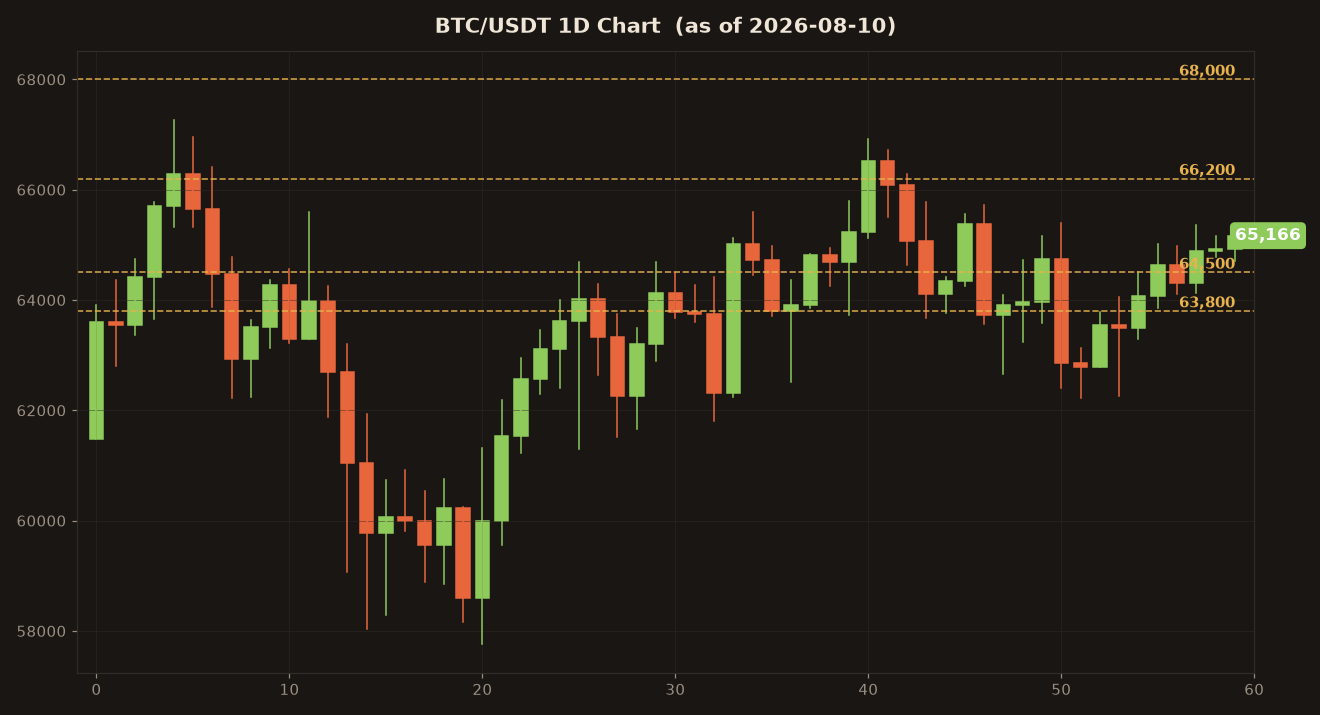
As the chart shows, Bitcoin is navigating a relatively tight technical range with clearly defined guardrails.
| Level | Price | Significance |
|---|---|---|
| Key Support | $63,800 | Major supply zone / demand shelf |
| Short-Term Support | $64,500 | Intraday pivot / recent consolidation floor |
| Near Resistance | $66,200 | Weekly high range — key breakout trigger |
| Psychological Resistance | $68,000 | Major round-number / sentiment inflection |
Futures data reinforces a cautious-but-leaning-long posture. The funding rate is a neutral +0.0094%, meaning no crowded long positioning that could cascade on a squeeze. The long/short ratio sits at 1.1, with 52.5% of accounts net long — a marginal lean without dangerous excess. Open interest grew 0.51% in 24 hours, a quiet accumulation signal rather than a speculative surge.
Trading scenario: A close above $66,200 on meaningful volume would constitute a trend breakout, opening a path toward $68,000. Until that trigger fires, leveraged long exposure should stay trimmed. The BIP-110 failure confirmed plus the $853M ETF inflow combo provides a modest fundamental tailwind for longs, but the on-chain activity deficit (active addresses -6.9% vs. 30-day average) argues against aggressive leverage. Invalidation on a long bias sits at a sustained break below $63,800.

Personal Take: Institutional Resilience Is Now Bitcoin’s Most Underrated Feature
My read is straightforward: the BIP-110 episode is actually net-positive for Bitcoin’s long-term narrative. Not because the attack was dangerous — it wasn’t — but because the market’s non-reaction proves the thesis. Two years ago, a fork headline combined with a regulatory ambiguity story would have printed a 10-15% correction in hours. Today, Bitcoin barely moved, ETF inflows hit a strong session number, and gold did the dramatic thing instead. That is a maturity shift worth marking. The institutional bid has created a demand floor that retail fear alone can no longer crack.
Risk Warning
Active addresses running nearly 7% below the 30-day baseline is a real concern. Without organic network growth, a price rally above $66,200 lacks on-chain confirmation and could reverse sharply. Any re-escalation of BIP-110 signaling — or a competing fork narrative gaining legitimate miner support — would reintroduce volatility that the current tight range has suppressed. Macro conditions could also flip rapidly if the next inflation print surprises to the upside and yields reverse the today’s drop.
FAQ
Why did Bitcoin ETFs see $853M in inflows despite the BIP-110 fork attempt?
Institutional analysts quickly determined BIP-110 lacked the supermajority hashrate support needed to threaten Bitcoin’s consensus chain. With only two blocks mined before stalling against 898.6 EH/s of network hashrate, the risk was negligible — and BlackRock’s IBIT led buying rather than selling.
What does BIP-110 actually mean for Bitcoin holders?
Nothing material. BIP-110 was a minority soft fork probe that failed to gain economic node or miner consensus. The dominant Bitcoin chain at $65,089 is unaffected, and the two orphaned blocks pose no chain-split risk.
Is Bitcoin overbought or oversold right now given the fear/greed index at 31?
At a fear/greed reading of 31 (Fear) with a funding rate of only +0.0094% and a long/short ratio of just 1.1, Bitcoin is far from overbought on sentiment metrics. The risk is insufficient momentum, not excess speculation — active addresses are 6.9% below the 30-day average, flagging weak trend-breakout energy.
If you found today’s post helpful, please subscribe and like.
Real-time briefings and new-post alerts on Telegram: t.me/corecryptoinsights · Follow on X: @core_trading1
If you’ve been trading without a fee payback, you’ve been losing money this whole time — start getting your trading fees back today.
▶ BingX 45% fee payback — full sign-up guide
▶ Bitunix 70% fee payback — full sign-up guide
▶ BingX vs Bitunix — which saves you more?
Leave a Reply