Bitcoin is falling below $60K because US spot Bitcoin ETFs have bled a record $4.71B in November. Tariffs and a 4.9% 10-year yield are pushing allocators to de-risk. Whales are absorbing the selling, but BTC still sits near $59,693, down 2.6% on the day. That makes whale buying a floor, not a reversal.

The Bitcoin tape has two headlines that seem to contradict each other. One says institutions are fleeing. The other says large holders are buying harder than ever. Both are true. Together they describe an ownership transfer happening in real time, and knowing who sits on each side is more useful than any single price print.
Who is selling Bitcoin right now?
Start with the headline fact. US spot Bitcoin ETFs have recorded $4.71B in net outflows in November, the largest monthly bleed since the products launched. 21Shares attributes it to two forces: weak fresh demand, and forced liquidations as leveraged positions tied to ETF exposure were unwound.
This wave is different from earlier outflow episodes in three ways.
- Size. Earlier outflow waves were mostly rotation, with money moving between issuers or leaving high-fee products. This one is a net exit from the asset class.
- Persistence. Prior waves usually reversed within a week or two. November’s selling has continued through bounces, including the brief push to $64K.
- Timing. It came while risk appetite was running elsewhere. Jensen Huang’s return lit up Nvidia and the AI complex, and BTC briefly tagged $64K before sellers pushed it back down. When an asset can’t join a broad risk-on rally, the problem is the holder base, not sentiment.
The sellers are mostly ETF allocators and TradFi wealth channels: advisors, model portfolios and multi-asset funds. They answer to risk committees, and those committees are looking at tariffs back in the headlines and a 10-year yield at 4.9%. For them, Bitcoin is a risk sleeve that can be trimmed. They are not making a conviction call.

Who is buying: whales and record loss supply
Now the counter-data. CoinDesk reports that the BTC supply held at a loss has hit an all-time high, and that large holders are the ones absorbing it. Glassnode separately logs the largest realized losses since the FTX collapse. In plain terms, coins bought higher are being sold at a loss, and whale cohorts are taking the other side.
Historically this combination shows up near cycle lows. Capitulating sellers realize losses, patient capital buys the underwater coins, and the cost basis of the supply resets lower. After FTX in late 2022, the same pattern of record realized losses plus whale absorption marked the bottom of a long base.
Where the FTX analogy breaks down
The FTX selling was a crypto-native credit event. Once the contagion cleared, there was no structural seller left. Today’s main seller is a structural flow channel, the ETF wrapper, and it responds to macro conditions that crypto doesn’t control. Back in 2022, the Fed pivot narrative was approaching. Today the rates backdrop reads as hawkish, with headlines pointing to rate-hike pressure and congressional scrutiny.
So whale accumulation can keep absorbing supply indefinitely without turning the trend, as long as a bigger pipe keeps pushing coins out the other end.
Why is Bitcoin not rallying with Nvidia and the Nasdaq?
Macro explains a lot of it. The Nasdaq fell 1.48% to 23,733.54 and the S&P 500 dropped 0.5% to 7,201.09. Gold fell 2.77% to $3,550.2, which tells you this was broad de-risking rather than a rotation into hedges. The dollar index eased 0.47% to 103.83. The 10-year yield ticked down 0.28% on the day, but a 4.9% level is still restrictive for long-duration assets.
Bitcoin’s failed breakout during the AI rally is the most telling detail. When equities were strong, BTC lagged. When equities turned, BTC fell with them. That asymmetry is typical of an asset whose marginal holder is selling into strength. Bitcoin dominance at 57.83% and ETH at $1,672.58 (▼3.02%) show the alt complex isn’t offering shelter either. HYPE fell 7.16% and SOL 4.88%.
Futures positioning: longs still crowded
Derivatives data argues against a quick bottom. Price fell 2.6% while open interest rose 4.28%, and 71.9% of accounts are long, a long/short ratio of 2.56. Traders are averaging down into a falling market. Funding at 0.008% isn’t overheated, but it isn’t negative enough to fuel a short squeeze either. If $58K breaks, those stacked longs become the liquidation fuel. The Fear and Greed Index sits at 11 (Extreme Fear), unchanged from yesterday, so crowd sentiment is bearish while positioning is still bullish. That mismatch rarely resolves upward.
What are today’s key BTC support levels?
| Level | Type | Why it matters |
|---|---|---|
| $64,000 | Major resistance | High of the Jensen Huang rally, where the breakout failed |
| $62,000 | Resistance / flip level | Reclaim needed to neutralize the short bias |
| $60,000 | Psychological pivot | Price currently trading just below it |
| $58,000 | First support | Break risks a long-liquidation cascade |
| $55,300 | Final defense | Prior swing low |
| ETH $1,600 / $1,800 | Support / resistance | ETH range boundaries |
On-chain data: activity up, dry powder thin
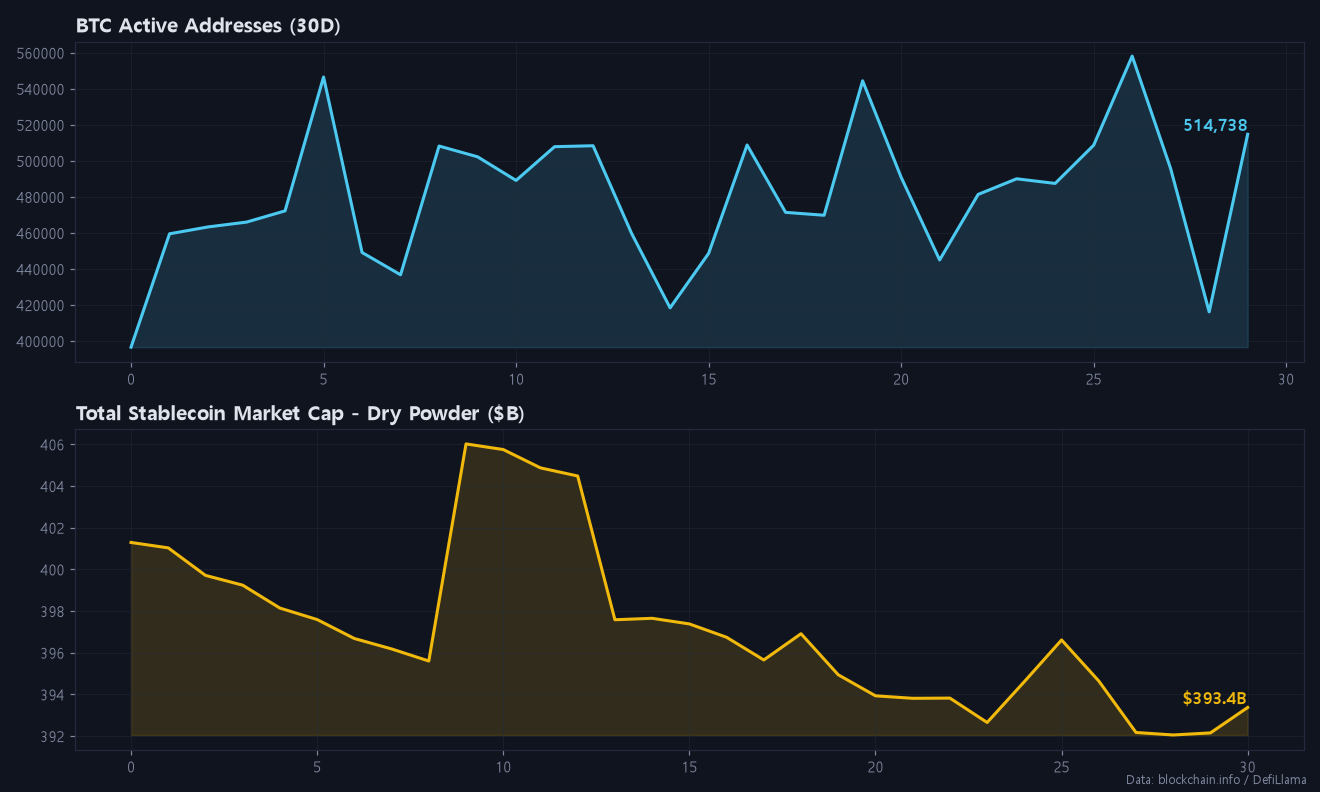
The network itself looks healthier than the price. Active addresses reached 514,738 today, above the 7-day average of 495,830 and 7.1% above the 30-day average. That is consistent with coins changing hands from weak holders to strong ones. Transaction count tells a quieter story: 513,383, down 14.8% versus its 30-day average. The mempool fast fee sits at just 1 sat/vB, so there’s no on-chain congestion and no speculative frenzy.
Hashrate is at 1,126 EH/s, up 3.3% over 30 days. Miners aren’t capitulating, which removes one classic source of forced selling.
The weak spot is liquidity. Stablecoin market cap stands at $393.4B. It rose $0.72B on the week but is down $7.93B over 30 days, sliding from around $401B at the start of the window. That is dry powder leaving the system, not building up. The chart below shows active addresses holding firm while the stablecoin base erodes. Whales are buying with existing capital, but fresh money isn’t arriving.
The quiet build: institutional plumbing keeps expanding
While price bleeds, the infrastructure keeps growing. Three items from this cycle stand out.
- Kalshi and Utah. Utah dropped its criminal case against Kalshi. That is a meaningful signal for prediction markets and for the broader question of how states treat crypto-adjacent event contracts.
- Anchorage Digital. The federally chartered crypto bank launched an asset-management arm. That gives advisors another regulated on-ramp, the same kind of channel currently selling, which could become a buyer once conditions turn.
- South Korea’s ICO reversal. The policy shift on token offerings fits a global pattern: major jurisdictions are moving from prohibition toward frameworks.
None of this moves price this week. It matters because the next ETF inflow wave will run through pipes that are being laid right now.
Trading the setup: short bias, sell the rallies
My stance is short-biased, selling bounces. The structure is a falling price with rising open interest, crowded longs and a macro headwind from ETF outflows, tariffs and a 4.9% 10-year yield. That favors fading strength until flows change.
- Short scenario (primary): entries scaled across $62,000-$64,000. Invalidation is a daily close above $64,500. Targets are $58,000, then $55,300 if the long cascade triggers.
- Breakdown short: a confirmed loss of $58,000 on volume, with the stop back above $60,000 and the target at $55,300.
- Long scenario (conditional): only after the flip signal below is confirmed. Enter on a retest of $62,000 as support, stop under $60,000, target $64,000 and above.
With this much chop, fees and funding add up quickly on repeated entries. Discount options such as a BingX referral code with 45% fee payback or the Bitunix 70% fee payback sign-up guide can cut that cost, and fee-payback signup links are also collected at the end of this post.
Risk warning: extreme fear readings like today’s 11 can produce violent short squeezes even in a downtrend. A single strong ETF inflow day or a soft yield print could send BTC through $62K quickly. Size positions so that a stop-out is survivable, and avoid high leverage while liquidation clusters sit on both sides.
What would flip the Bitcoin outlook?
The framework is simple: three consecutive days of net ETF inflows plus a reclaim of $62K. Flows tell you the structural seller has stopped. The price reclaim tells you whale demand has turned from absorption into markup. Until both happen, treat whale bids as floor-building, not trend reversal.
FAQ
Why is Bitcoin down today?
BTC fell 2.6% to about $59,693 as record November ETF outflows of $4.71B met a 1.48% Nasdaq drop and tariff worries. The 10-year yield at 4.9% adds to the pressure.
Are whales buying Bitcoin?
Yes. Large holders are absorbing record supply held at a loss while Glassnode shows the biggest realized losses since FTX. So far that buying is building a floor rather than reversing the trend.
What is the key Bitcoin support level?
$58K is first support and $55.3K is the final line. Resistance sits at $62K and $64K.
If you found today’s post helpful, please subscribe and like.
Real-time briefings and new-post alerts on Telegram: t.me/corecryptoinsights · Follow on X: @core_trading1
If you’ve been trading without a fee payback, you’ve been losing money this whole time — start getting your trading fees back today.
▶ BingX 45% fee payback — full sign-up guide
▶ Bitunix 70% fee payback — full sign-up guide
▶ BingX vs Bitunix — which saves you more?
Leave a Reply