
Not yet. After the Democratic sweep, the 10-year Treasury yield rose to 4.95%, the dollar index slipped to 101.52 and gold jumped 2.3% to $4,031. Bitcoin gained a smaller 1.85% to about $77,900. Its rebound tracked the Nasdaq more closely than hard assets, so for now BTC still trades like long-duration tech.

The bond market’s verdict on the blue wave
Start with Treasuries, not crypto. With Democrats taking both chambers of Congress, the 10-year yield climbed to 4.95%, a 1.19% move on the day. Rising yields on their own can mean stronger growth or a hawkish Fed. Rising yields alongside a weaker dollar point to something else. The DXY fell 0.35% to 101.52 while gold rallied to a record-type print of $4,031.
That combination reads as term-premium repricing. Investors are asking for more compensation to hold long-dated US debt because they expect larger deficits and bigger spending packages. When the bond market starts pricing fiscal risk, the usual response is to buy assets that sit outside the sovereign balance sheet. Gold got that bid today. The question is whether Bitcoin, often pitched as “digital gold,” is getting it too.
The short answer is no, at least not yet.
Is Bitcoin trading like gold or like tech right now?
The scoreboard makes the point. Here is how the main assets moved over the session:
| Asset | Level | 1-Day Change | Read |
|---|---|---|---|
| US 10Y Yield | 4.95% | ▲ 1.19% | Term premium rising |
| Dollar Index (DXY) | 101.52 | ▼ 0.35% | Fiscal-risk discount on USD |
| Gold | $4,031 | ▲ 2.30% | Clean debasement bid |
| Bitcoin | $77,912 | ▲ 1.85% | Lagging gold |
| Nasdaq | 25,372 | ▲ 0.83% | Risk appetite intact |
| S&P 500 | 7,568.92 | ▲ 0.36% | Modest gains |
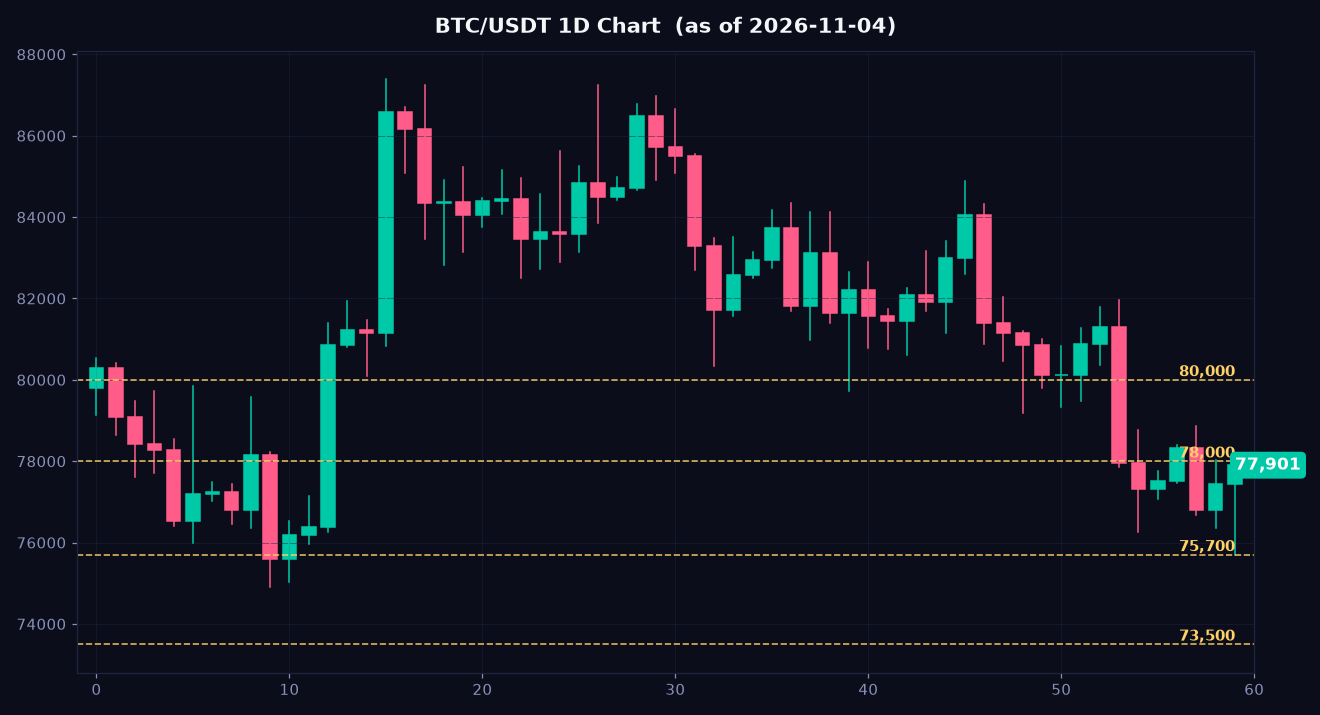
Bitcoin rose, but it underperformed gold on the clearest debasement day in weeks. More telling is the shape of the move. BTC fell to roughly $75.7k on election day, then staged a V-shaped recovery toward $78k as US equities firmed. That path followed Nasdaq risk appetite rather than the steady, macro-driven grind you see in gold. On a seven-day basis BTC is still down 3.57%, and Solana (-8.64%) and BNB (-5.95%) show that higher-beta crypto has had a rough week.
Ethereum did a little better on the day at $2,295 (+2.28%), and privacy coin Zcash jumped 12.25%. Still, BTC dominance at 59.35% tells you capital is staying concentrated in the largest asset rather than spreading into a broad risk-on rally.
What are today’s key BTC support and resistance levels?
The technical map is straightforward. The election-day low near $75.7k is the line that matters most, with secondary support at $73.5k. $78k is the short-term pivot that price is now testing. Above that, $80k is first resistance and $83k is the next ceiling. For Ethereum, $2,200 is support and $2,400 is resistance.
As the chart shows, the bounce from $75.7k was sharp, but BTC has not reclaimed the levels it lost earlier in the week. A daily close above $78k would turn the pivot into support and open the way toward $80k.
Derivatives data supports a cautious, constructive reading. Funding sits at a neutral 0.01%, and open interest fell 0.89% during the rebound. Price rose while leverage declined, which points to short covering and spot buying, not a crowded long build-up. Rallies like this tend to hold up better than ones driven by leverage, though they rarely run very far without new demand.
On-chain data: dry powder, but no rush
The network data looks steady rather than euphoric. Active addresses came in at 466,000 today, slightly above the seven-day average of about 459,700 but 1.3% below the 30-day mean. The 30-day series has swung between roughly 397,000 and 528,000 without a clear trend, which suggests stable participation but no surge of new users. Transaction count is weaker at 642,252, down 13.2% against the 30-day average, and fast mempool fees are just 2 sat/vB. Blockspace demand is soft.
Stablecoins are the more interesting signal. Total stablecoin market cap stands at $408.9B, up $6.31B over seven days after dipping toward $398.8B late in the month. That rebound points to fresh dry powder entering crypto rails, capital that can move into BTC quickly if the macro backdrop turns supportive. Hashrate is at 1,006 EH/s, down 13.3% over 30 days. That pullback is worth watching for miner stress, though it is not alarming at these levels.
The on-chain chart below shows the pattern clearly: flat activity, a recovering stablecoin base, and no speculative frenzy.

Institutional and geopolitical threads
Moscow Exchange: de-dollarization in practice
The sanctioned Moscow Exchange plans to list BTC and USDT in December. That is the de-dollarization use case in its most literal form: a state-linked venue cut off from Western finance turning to crypto rails for settlement and value storage. It supports the long-term “neutral reserve asset” thesis. It also adds regulatory and headline risk, and the USDT angle could draw fresh scrutiny of stablecoin issuers from Washington.
Block’s DOJ settlement: the compliance drag
On the corporate side, Block faces a $764M DOJ settlement while its bitcoin profit has halved. For allocators who gain crypto exposure through equities, this is a reminder that corporate wrappers bring compliance costs, legal overhang and margin pressure that spot BTC does not. Holding Bitcoin through a listed company is not the same exposure as holding it directly.
Taken together, these headlines describe an asset with strong structural stories that is still being priced day to day by the same risk appetite that drives tech stocks.
What happens to Bitcoin if the 10Y yield hits 5%?
This is the question allocators need to answer. A break of 5% on the 10-year is both a psychological threshold and a valuation one.
Scenario A: BTC trades like gold
If the yield breaks out because of fiscal fear, with the dollar sliding and gold extending gains, Bitcoin could finally decouple and pick up the debasement bid. Signs to watch: BTC outperforming the Nasdaq on down-equity days, stablecoin supply continuing to grow, and steady ETF inflows. Positioning: buy pullbacks in the $76k-$77k zone, stop below $75.7k, first target $80k and extension to $83k.
Scenario B: BTC trades like long-duration tech
If 5% acts as a discount-rate shock and growth stocks reprice lower, BTC is likely to fall with them, which is how it has traded so far. Positioning: avoid chasing longs near $80k. Consider short hedges on a rejection between $79.5k and $80k, invalidated above $81k, targeting $75.7k and then $73.5k.
Execution matters in both cases. Hedging and re-entering add up in fees, so comparing a BingX fee payback program for active traders with the Bitunix 70% fee rebate sign-up guide is worth a few minutes. Fee-payback signup links are also at the end of this post.

My view
My bias is neutral with a slight long tilt for the short term. The rebound came on falling open interest and flat funding, which makes it healthier than it looks. Buying dips with a stop at $75.7k offers a reasonable risk/reward. Over the longer horizon, though, I am not buying the claim that Bitcoin has already become a debasement hedge. Gold earned that label today and BTC did not. Until Bitcoin outperforms on a day when the Nasdaq falls and yields rise, I would size it as a high-beta macro asset, not a portfolio insurance asset.
Risk warning: a decisive 10-year break above 5% combined with an equity sell-off could push BTC through $75.7k quickly, and the next meaningful support at $73.5k sits about 6% below current prices. Leverage magnifies that kind of move. Size positions so that a stop-out is survivable.
FAQ
Why did gold outperform Bitcoin today?
Gold rose 2.3% to $4,031 on fiscal-debasement fears, while Bitcoin gained 1.85%. BTC’s bounce tracked Nasdaq risk appetite more than hard-asset demand.
What is Bitcoin’s key support level right now?
The election-day low near $75.7k is primary support, with $73.5k below it. $78k is the short-term pivot and $80k is first resistance.
Is the crypto market overleveraged?
No. Funding is neutral at 0.01% and open interest fell 0.89% during the rebound, which points to spot buying and short covering rather than excess leverage. The Fear & Greed Index sits at 34, still in Fear territory.
If you found today’s post helpful, please subscribe and like.
Real-time briefings and new-post alerts on Telegram: t.me/corecryptoinsights · Follow on X: @core_trading1
If you’ve been trading without a fee payback, you’ve been losing money this whole time — start getting your trading fees back today.
▶ BingX 45% fee payback — full sign-up guide
▶ Bitunix 70% fee payback — full sign-up guide
▶ BingX vs Bitunix — which saves you more?
Leave a Reply