Mostly yes, but the risk is now priced differently. Binance has fully restored withdrawals four weeks after a $6.3 billion hack. Stablecoin supply held near $393.6B, so capital is rotating toward self-custodial venues rather than leaving crypto. Bitcoin’s muted +2.25% bounce, with the Fear and Greed Index at 12, shows trust is not yet rebuilt.

The news hook: Binance reopens the exits
Four weeks after a breach reported at $6.3 billion, Binance says customer withdrawals are fully restored. For most retail users, the story ends there. Coins can move again.
For institutions, it does not. The four-week freeze was a live stress test of a question allocators had treated as theoretical: what happens when the largest venue in crypto cannot release client assets on demand? The answer was a month of trapped capital, forced hedging on other venues, and a sharp rise in what we would call the custody premium. That is the extra return, or the discount on convenience, investors now demand for leaving assets with a third party.
The freeze unfolded in three phases. The first was the hack and an immediate halt. The second was a staged reopening with limits and manual reviews. The third, announced today, is full restoration. Each phase pushed a little more volume onto self-custodial and on-chain venues, and that migration has not reversed.

How are regulators responding to crypto custody risk?
Today’s headlines share a single theme seen from different jurisdictions. Custody risk is no longer only about hackers. It now carries a regulatory dimension too.
| Jurisdiction / Source | Development | What it means for custody risk |
|---|---|---|
| Spain | Anti-laundering unit granted power to freeze crypto accounts without a judge | Freeze risk can now come from an administrative order, not only a court or a hack |
| Japan | Crypto security group taps SEAL to speed up hack response | Faster incident coordination could shorten future freezes |
| CoinDesk (advisors) | Checklist on whether to trust exchanges | Due diligence is moving from optional to expected |
Put side by side, these moves pull in opposite directions. Japan is trying to shrink the duration of hack-driven freezes. Spain is widening the legal paths through which a freeze can happen at all. An allocator holding crypto on a European-licensed venue now has to model two separate failure modes: a technical breach, and an account freeze ordered without judicial review.
Washington’s ongoing crypto policy fight, covering everything from strategic bitcoin reserves to memecoin controversies, adds a third layer of uncertainty for US-domiciled funds. The common thread is that jurisdiction is now part of counterparty risk.
Is crypto money leaving the market or just moving?
The flow data points to rotation, not flight. Total stablecoin supply sits at $393.6B, down only $1.05B over seven days and $5.66B over 30 days. A real exit from crypto would show up as faster stablecoin redemptions. Instead the dry powder is mostly still on-chain, waiting.
Where it is going shows up in the leaderboard. Hyperliquid (HYPE) led the day ▲8.53% to $66.12, followed by Lighter (LIT) +7.88% and Jupiter (JUP) +7.21%. All three are self-custodial trading venues, two of them perp DEXs. HYPE now sits inside the top 10 by market cap, which is a striking signal of where active traders want their margin to live after watching a centralized venue lock up for a month.
Moving to on-chain venues does not remove trading costs. It shifts them into gas, slippage and funding. Traders still splitting activity across centralized platforms should compare effective fees; options like the BingX fee payback program for active traders or the Bitunix 70% fee payback sign-up guide can materially lower that drag. Fee-payback signup links are also collected at the end of this post.
On-chain data: participation is soft, dry powder is intact
Bitcoin network activity confirms a market that is cautious but not capitulating.
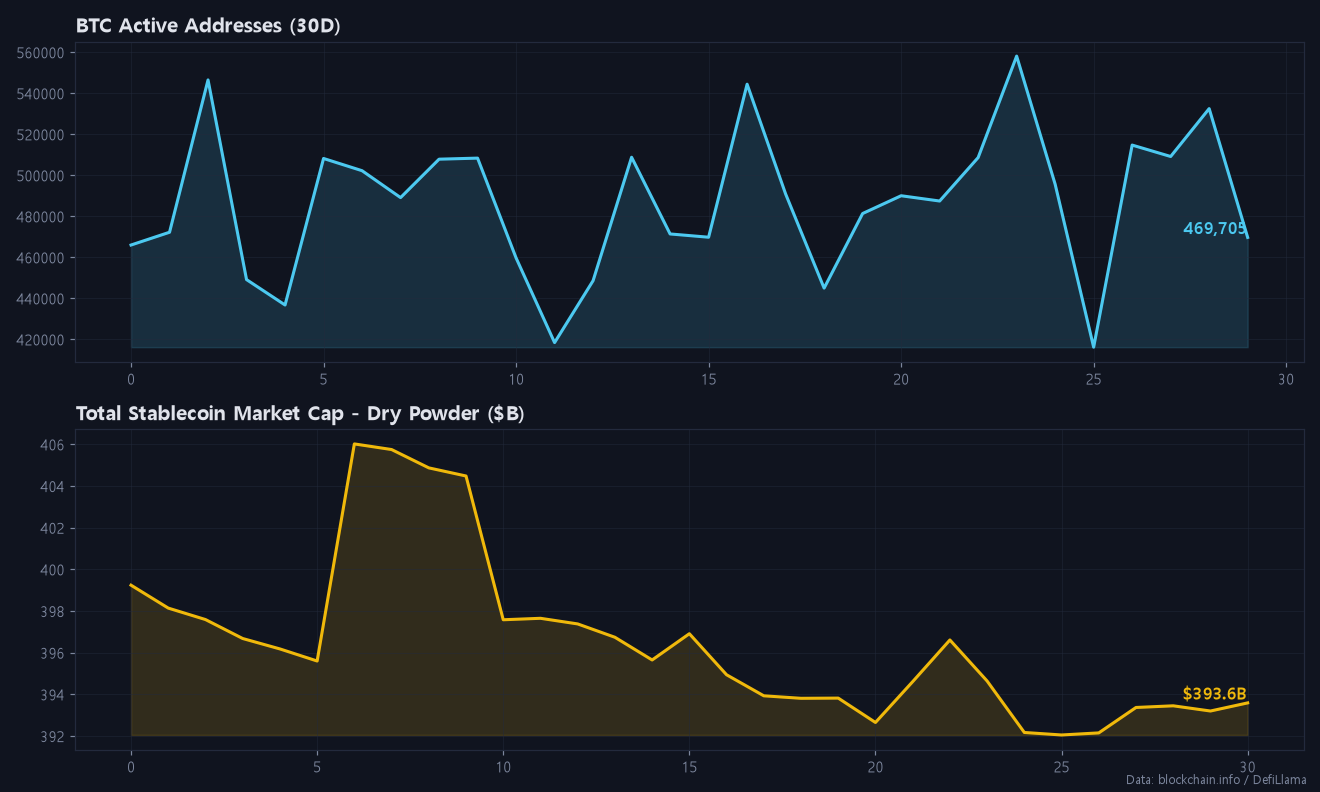
- Active addresses: 469,705 today, below the 7-day average of 499,439 and 3.5% under the 30-day mean. Participation is drifting lower, without a collapse.
- Transactions: 573,988, down 1.4% versus the 30-day average. The fast mempool fee is just 1 sat/vB, so there is no on-chain urgency.
- Hashrate: 904.8 EH/s, down 10.1% over 30 days. That fits reports that mining costs now exceed spot for many operators, which raises the risk of miners selling their holdings.
- Stablecoin market cap: $393.6B, roughly flat over the week. Sidelined capital remains available for redeployment.
As the on-chain chart below shows, stablecoin supply has hugged the $392B to $397B band for most of the month after a brief spike above $406B. That is consolidation, not drainage. The falling hashrate is the more worrying signal for Bitcoin specifically.
Why isn’t Bitcoin acting as a safe haven today?
The macro tape is textbook risk-off. Gold jumped +4.32% in a single day to $3,688.4. The Nasdaq fell 0.62% and the S&P 500 slipped 0.25%. The 10-year Treasury yield eased to 4.85%, and the dollar index was flat at 103.67. Safe-haven demand is clearly real.
It is bypassing Bitcoin. BTC rose 2.25% to $61,757 but is down 0.34% on the week, and Ethereum’s +2.9% day still leaves it flat over seven days at $1,733.5. Bitcoin dominance at 58.01% shows money concentrating in the largest asset rather than spreading out. Even so, the bounce lacks conviction. When gold rallies more than 4% and Bitcoin barely holds its weekly range, allocators are telling you they still classify crypto as a risk asset carrying unresolved custody questions.
The derivatives data reinforces that read. Open interest rose 2.75% alongside price, so this bounce is leverage-driven. Long accounts make up 70.3% of positions, a long/short ratio of 2.37, which means the crowd is heavily one-sided. Funding at 0.0055% is not overheated, but positioning is crowded ahead of a roughly $7.6B options expiry contested around $60k.
What are today’s key Bitcoin support and resistance levels?
| Asset | Support | Resistance | Price / 24h |
|---|---|---|---|
| BTC | $60,000 (options battleground) | $63,500 / $65,000 | $61,757 ▲2.25% |
| ETH | $1,650 | $1,850 | $1,733.5 ▲2.9% |
| HYPE | $60 | $70 (breakout confirms relative-strength trend) | $66.12 ▲8.53% |
Base case: neutral to mildly short. Fading rallies into the $63,000 to $64,000 zone in scaled entries offers the better risk/reward. Invalidation sits above $65,000. The first target is $60,500, with a test of $60,000 possible if longs unwind. Because funding is not stretched, aggressive shorting is not warranted. The approach is to sell rallies, not to chase breakdowns.
Alternative scenario: a clean daily close above $65,000 would flip the bias. Wait for a retest of $63,500 as support, with a stop below $62,000, before considering longs. A loss of $60,000 is the opposite trigger. With 70.3% of accounts long, a break there risks a liquidation cascade toward lower levels.
HYPE is better treated as a relative-value trade, long HYPE against short BTC, than as a naked long. A break above $70 would confirm the trend. A move back under $60 would cancel the pair thesis.
Our view: the custody premium is here to stay
In my view, the market is underestimating how permanent this shift is. Binance reopening withdrawals does not reset the clock. Allocators now have a month-long precedent, and Spain has shown that freeze risk can come from a regulator’s desk as well as a hacker’s exploit. I expect self-custodial venues to keep a structural share gain even after sentiment recovers. I also expect institutions to demand withdrawal SLAs in writing before re-entering size on any centralized exchange.
Risk warning: self-custody is not risk-free. Smart-contract exploits, oracle failures and key-management errors replace counterparty risk with operational risk. Perp DEX tokens that rallied 7% to 9% in a day can reverse just as fast in an Extreme Fear market. Size positions accordingly.
Custody due diligence checklist for advisors and allocators
- Proof of reserves: Is it audited, covering liabilities as well as assets, and updated at least monthly?
- Jurisdictional freeze exposure: Can local authorities freeze accounts without a court order, as Spain now permits?
- Withdrawal SLAs: Are there written commitments on processing times during an incident, and what is the venue’s track record?
- Incident response: Does the venue participate in rapid-response networks such as the SEAL partnership adopted in Japan?
- Asset segregation: Are client assets held bankruptcy-remote, in cold storage, with insurance limits disclosed?
- Self-custody trade-offs: Weigh freeze immunity against smart-contract risk, key-loss risk and fragmented liquidity.
- Concentration limits: Cap exposure to any single venue as a share of the portfolio.
FAQ
Is it safe to withdraw from Binance now?
Binance says withdrawals are fully restored four weeks after the $6.3 billion hack. Allocators should still apply venue concentration limits and verify proof of reserves.
Is money leaving crypto after the hack?
Not broadly. Stablecoin supply is $393.6B, down only $1.05B over seven days, which suggests rotation toward venues like Hyperliquid (+8.53%) rather than an exit.
What is Bitcoin’s key support today?
$60,000 is the critical level, contested ahead of options expiry. Resistance sits at $63,500 and $65,000, with BTC trading at $61,757.
If you found today’s post helpful, please subscribe and like.
Real-time briefings and new-post alerts on Telegram: t.me/corecryptoinsights · Follow on X: @core_trading1
If you’ve been trading without a fee payback, you’ve been losing money this whole time — start getting your trading fees back today.
▶ BingX 45% fee payback — full sign-up guide
▶ Bitunix 70% fee payback — full sign-up guide
▶ BingX vs Bitunix — which saves you more?
Leave a Reply