Bitcoin is lagging gold today because safe-haven money still prefers bullion. Gold rose 1.63% to $3,593 while Bitcoin gained only 0.94% to about $60,741. That happened even as Iran was reported to be collecting Strait of Hormuz tolls in BTC. The war-adjacent headline cast Bitcoin as a sanctions rail rather than a hedge, and institutions noticed.

Gold up 1.6%, Bitcoin barely moving: what happened?
On a day built for a digital-gold story, the old gold won. Bullion pushed into record territory at $3,593.40. US equities slipped, with the S&P 500 down 0.25% and the Nasdaq down 0.62%. The dollar index edged up to 103.78. Bitcoin managed a modest bounce, but it is still down 2.51% on the week. The Fear and Greed Index sits at 11, deep in Extreme Fear, slightly worse than yesterday’s 13.
The timing is awkward for the bull case. Reports surfaced that Iran is charging transit tolls in the Strait of Hormuz and accepting payment in Bitcoin and China’s digital yuan. In theory, that is a real-world use case: a state actor using crypto to move value outside the dollar system. In practice, the capital that fled geopolitical risk went straight to gold. It did not go to BTC.
That split tells you how allocators see Bitcoin right now. To them it is not a crisis hedge. It is a risk asset with a growing compliance problem.
Is Iran’s Bitcoin toll good or bad for Bitcoin?
It cuts both ways. The bullish reading is simple: censorship-resistant settlement works, and even nation-states are using it. That is the original cypherpunk pitch, proven under live geopolitical stress.
The institutional reading is less friendly. Pension funds, RIAs and corporate treasuries were sold Bitcoin as digital gold, a neutral reserve asset that sits comfortably inside regulated wrappers like spot ETFs. A headline linking BTC to sanctions evasion in a strategic shipping lane pushes the asset toward a different label: sanctions rail. Compliance committees move slowly, and they rarely move toward assets that show up next to the word Iran.
That shift in identity invites a regulatory squeeze, and the squeeze is already visible.

Europe and Asia tighten the screws on accounts and self-custody
Three stories from the same news cycle point in the same direction:
- Spain is moving to let its anti-money-laundering unit freeze crypto accounts without a judge’s order. That puts administrative freeze powers on a fast track.
- Japan is weighing oversight of DeFi protocols and self-custodial wallets. Those are the two areas that have so far sat outside traditional supervision.
- Zodia Custody, the custody arm backed by Standard Chartered, disclosed a data breach. That is an uncomfortable reminder for institutions that outsource key management.
Then there is the privacy angle. A developer showed that sending a tiny payment to a wallet can expose that wallet’s IP address. Monero is trending as a result. Put it together and the picture is clear. Regulators want more visibility, users want less, and Bitcoin sits in the crossfire. It is too transparent for privacy maximalists and too associated with sanctions for compliance officers.
What are today’s key Bitcoin support and resistance levels?
Price is boxed in around a round number. Here are the levels that matter across the majors:
| Asset | Price | 24h | Support | Resistance |
|---|---|---|---|---|
| BTC | $60,741 | ▲0.94% | $60,000 / $58,500 | $62,500 / $63,800 |
| ETH | $1,702.82 | ▲1.00% | $1,650 | $1,780 |
| SOL | $71.43 | ▲1.30% | $68 | $75 |
| HBAR | $0.0549 | ▲5.87% | – | – |
| SKY | $0.0460 | ▲11.75% | – | – |
A roughly $7.6 billion options expiry is approaching, and that tends to pin price near big strikes. Expect Bitcoin to gravitate toward $60,000 until it passes.
Coin notes: BTC, ETH, XMR, HBAR, SKY and HYPE
BTC: sanctions rail vs. institutional thesis
Bitcoin dominance stands at 57.92%, so capital is still hiding in BTC within crypto. It is just not flowing into crypto from outside. Recent reports of spot ETF outflows undercut every bounce. Headlines also point to long-term holders realizing losses, which echoes earlier capitulation phases. Until ETF demand returns, the Iran story is more likely to be a compliance footnote than a catalyst.
ETH: no safe-haven bid near $1,700
Ethereum trades at $1,702.82. It is down 3.67% on the week, underperforming Bitcoin, and there is no geopolitical narrative propping it up. The $1,650 floor is the line to watch. A clean break above $1,780 would be needed to change the tone.
XMR: privacy demand returns
The wallet IP-leak research handed Monero a fresh narrative. Interest is rising just as Spain and Japan move toward tighter surveillance. That tension is exactly why privacy coins face delisting risk on regulated venues. Demand and access are moving in opposite directions.
HBAR and SKY: today’s movers
Hedera gained 5.87% to $0.0549, one of the stronger large-cap moves. Sky, the rebranded Maker ecosystem token, jumped 11.75% to about $0.046 and led the mid caps. Neither move reflects a broad risk-on rotation. Both look like rotation into specific stories within a fearful market.
HYPE: exchange-token resilience
Hyperliquid rose 2.51% to $63.37, despite a 6.55% weekly drop and news that market maker Auros is winding down. Losing a liquidity provider normally hurts an exchange token. HYPE’s ability to hold above $60 suggests on-chain perp venues still have sticky demand.
Futures and macro: how crowded is the long side?
The funding rate is a neutral 0.01%, but positioning is lopsided. The long/short ratio is 2.4, with 70.6% of accounts long. Open interest rose 0.62% in 24 hours. That means leverage is still building into a fearful tape, and leftover longs are fuel for a flush.
Macro offers only partial relief. The 10-year Treasury yield eased to 4.85%, but a firmer dollar and softer tech stocks offset it. Lower yields help long-duration assets in theory. They have not been enough to turn flows yet.
If you are actively trading this range, costs add up quickly on both entries and stop-outs. Fee-payback signup links are at the end of the post. Traders who scalp the options-expiry chop can compare the BingX 45% fee payback guide with the Bitunix 70% fee payback sign-up guide.
Trading scenarios
- Short (primary bias): fade rallies into $62,000-$62,500. Invalidate on a sustained move above $63,800. Targets are $60,000, then $58,500.
- Breakdown extension: a decisive loss of $58,500 opens room for further downside. In that case, add only on retests from below.
- Contrarian long: Extreme Fear at 11 and rising dormant supply raise squeeze risk. A long from $58,500-$59,000 with a stop just under $58,000 targets $60,000-$62,500. Size it small, because the trend is not your friend here.
On-chain data: is the network weakening?
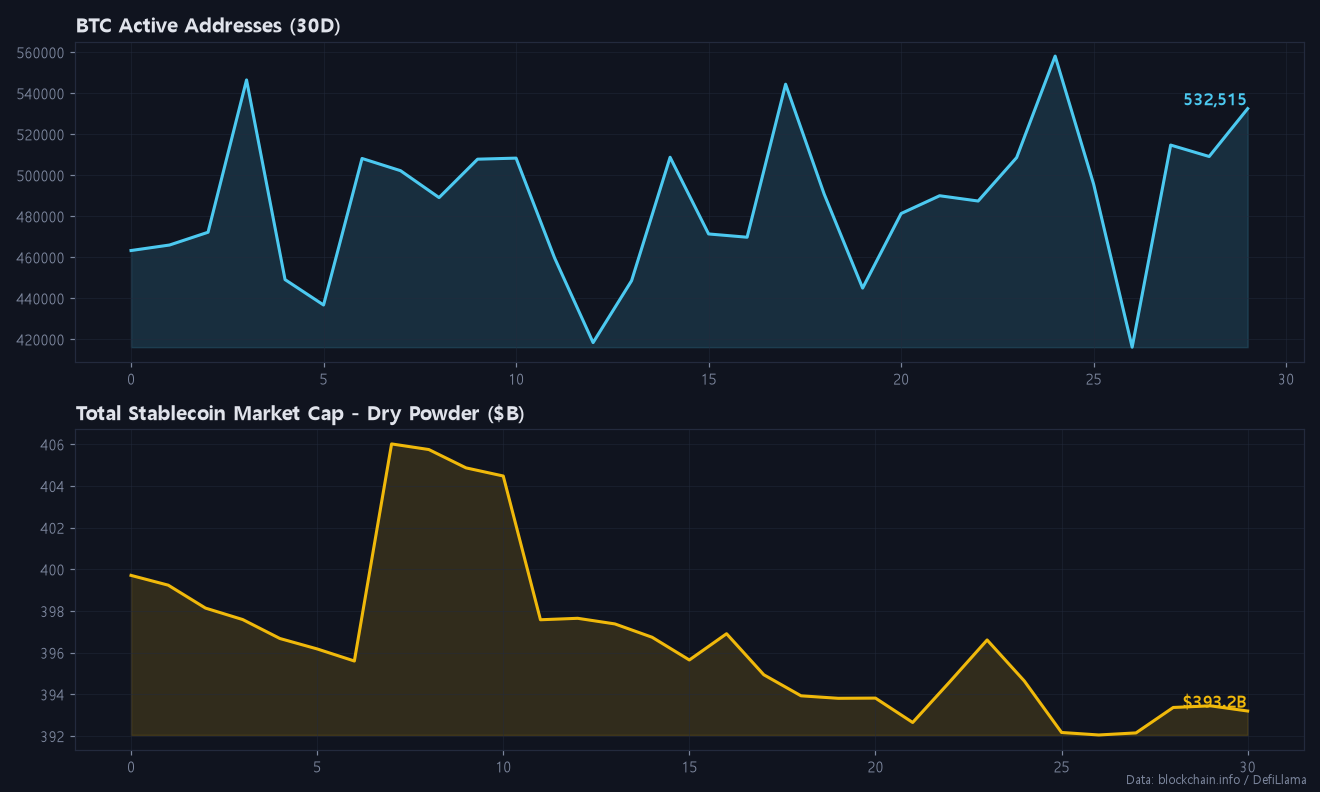
Underneath the price, network activity is surprisingly firm. Active addresses reached 532,515 today. That is above the 7-day average of 505,002 and 9.4% above the 30-day average. Transaction count climbed to 696,976, up 18.5% versus its 30-day mean. Yet mempool fees sit at just 4 sat/vB, so the extra activity is not congesting blocks.
The weak spot is dry powder. Stablecoin market cap slipped to $393.2 billion, down $3.41 billion in a week and $6.51 billion over 30 days. Sidelined dollars are leaving the ecosystem rather than waiting to buy. Hashrate is 1,072.3 EH/s, down 2.9% over 30 days. That is a mild cooling and likely reflects margin pressure on miners at these prices. The chart below shows active addresses trending higher while the stablecoin supply drifts lower.
Does geopolitical utility help or hurt Bitcoin’s institutional case?
My view: in the short run, it hurts. The Iran toll proves Bitcoin works, but it proves it for the wrong client. Institutional capital entered through ETFs on the promise of a regulated, neutral store of value. Every sanctions headline hands regulators in Madrid, Tokyo and elsewhere another argument for freeze powers and wallet oversight. Over a five-year horizon, credible neutrality may become Bitcoin’s strongest selling point. Over the next five weeks, it is a compliance headwind. I would not expect today’s narrative to reverse ETF outflows.
Risk warning: crowded longs at a 2.4 ratio, a large options expiry and thin stablecoin inflows make a sharp wick in either direction likely. Leverage at these levels can be wiped out within hours. Keep stops tight and size conservatively.
What would change the picture?
- Falling 10-year yields: a sustained move well below 4.85%, paired with a weaker dollar, would ease the macro headwind.
- A reversal in ETF flows: consecutive days of net spot ETF inflows would show institutions looking past the sanctions narrative.
- Clarity on freeze powers: clear judicial safeguards in Spain’s plan, or a light-touch outcome on Japanese self-custody rules, would reduce the regulatory discount.
FAQ
Why did gold rise while Bitcoin stayed flat?
Safe-haven flows went to bullion, which gained 1.63% to $3,593. Bitcoin rose only 0.94% because institutions still treat it as a risk asset.
What is Bitcoin’s key support today?
First support is $60,000 and second support is $58,500. A break below $58,500 opens the door to deeper losses.
Is the crypto market oversold?
Sentiment is extreme, with the Fear and Greed Index at 11. However, longs still make up 70.6% of accounts, so a final leverage flush remains possible.
If you found today’s post helpful, please subscribe and like.
Real-time briefings and new-post alerts on Telegram: t.me/corecryptoinsights · Follow on X: @core_trading1
If you’ve been trading without a fee payback, you’ve been losing money this whole time — start getting your trading fees back today.
▶ BingX 45% fee payback — full sign-up guide
▶ Bitunix 70% fee payback — full sign-up guide
▶ BingX vs Bitunix — which saves you more?
Leave a Reply