Bitcoin is falling today because institutional liquidity is leaving crypto at the same time an AI-led equity selloff forces a cross-asset dash for cash. BTC trades near $58,188, down 5.93% in 24 hours after slipping below $57K intraday, while XRP ETF assets fell under $1 billion and stablecoin supply shrank by $9.9 billion.

Two headlines describe the same problem. CoinDesk reported that XRP fell about 10% as leveraged long bets unwound and assets in XRP exchange-traded funds slipped below the $1 billion mark. Bitcoin, meanwhile, broke below $57,000 intraday for the first time in roughly two years and extended a seven-week losing streak. Neither story is really about one token. Both are about money leaving the system, and about which assumptions from the last bull market are now being tested.
Why did XRP ETF assets fall below $1 billion?
The altcoin ETF experiment is facing its first real stress test. When spot products for tokens beyond Bitcoin and Ether launched, the pitch was straightforward: an ETF wrapper brings in advisers, model portfolios and long-term allocators, so demand becomes stickier than exchange-based speculation. That theory held up well while prices were rising.
Under pressure it looks different. XRP now trades around $0.899, down 7.03% over 24 hours and 9.76% over the week, and the fall in ETF assets below $1 billion reflects both price declines and holders choosing to exit. A wrapper changes who can buy an asset. It does not change why they hold it. If the allocation was momentum-driven, the redemption will be momentum-driven too.
This matters beyond XRP. Several altcoin products were sold to issuers on the idea that a regulated vehicle would create a stable bid. The sub-$1 billion print suggests that “ETF equals sticky demand” was a bull-market assumption. In a risk-off tape, ETF shares are simply another liquid line item that a portfolio manager can sell before close.

The wider damage across large caps
The selling is broad. Ether is down 6.2% on the day to $1,635.98. BNB lost 7.83%, Solana fell 6.19% to $68.12, and Hyperliquid’s HYPE dropped 10.72%. TRON held up better at -2.22%. Bitcoin dominance stands at 57.65%, a sign that capital is consolidating rather than rotating into riskier names. The Fear and Greed Index sits at 12, firmly in “Extreme Fear,” and was unchanged from the previous reading.
Is crypto’s dry powder really waiting on the sidelines?
A common bull argument during drawdowns is that cash is parked in stablecoins, ready to buy the dip. The data doesn’t support that right now.
On-chain data: stablecoins, addresses and hashrate
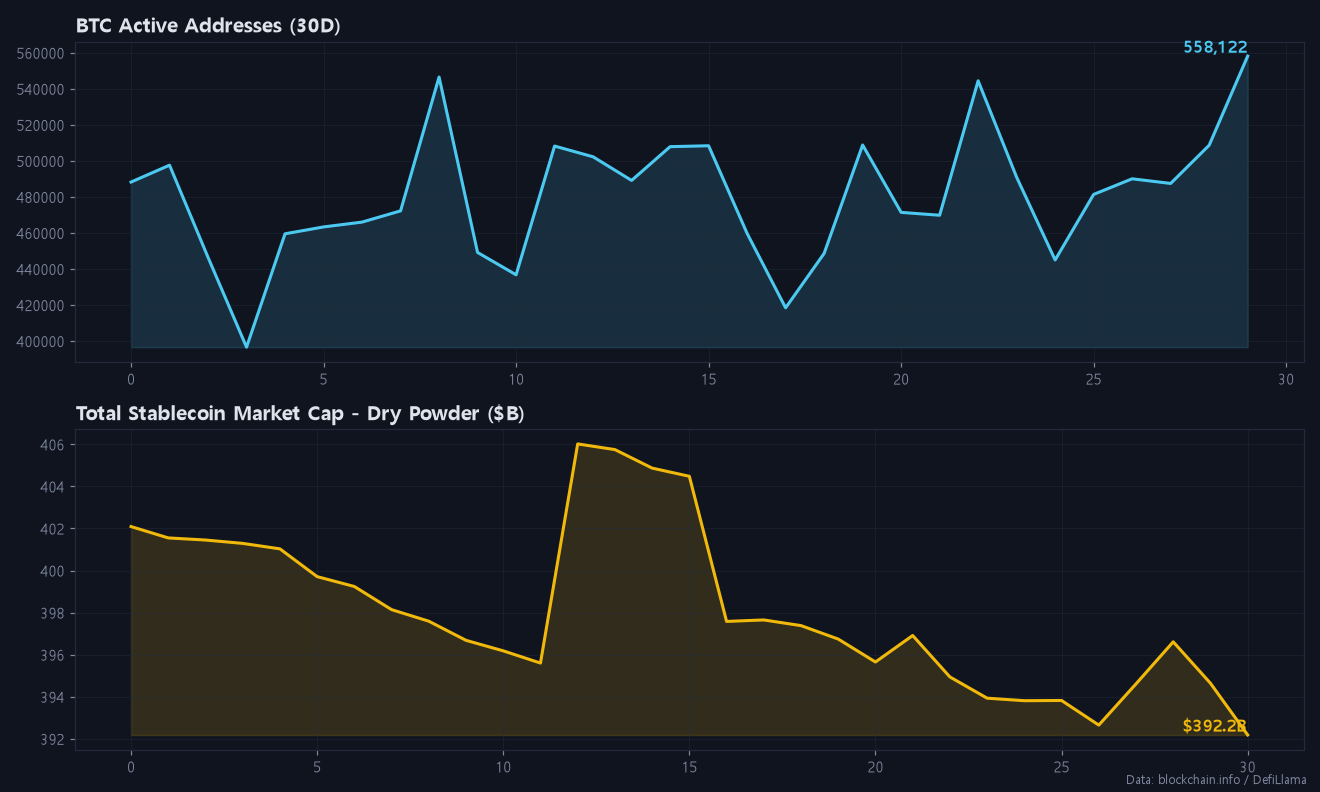
Total stablecoin market capitalization has fallen from $402.09 billion to $392.2 billion over 30 days, a contraction of $9.9 billion, including $1.75 billion in the past week alone. A brief jump to about $406 billion midway through the period faded within days, which looks more like temporary parking than fresh capital. Shrinking stablecoin supply usually means redemptions back to dollars. That money leaves crypto rather than waiting inside it.
Network activity tells a split story. Bitcoin active addresses reached 558,122 today, 16.1% above the 30-day average and well above the 7-day average of 494,500. Transaction count, however, is 10.1% below its 30-day average at 551,067, and fast mempool fees are just 2 sat/vB. More addresses moving fewer transactions at very low fees fits a capitulation pattern: coins being shuffled to exchanges or consolidated, not a rush of new economic activity.
Miners are not leaving. Hashrate stands at 978.5 EH/s, up 9.4% over 30 days. Network security is intact, but rising hashrate alongside falling prices squeezes miner margins and can add sell pressure if the drawdown continues. The on-chain chart below shows the 30-day stablecoin and active address trends side by side.
Why aren’t falling yields helping Bitcoin?
On paper, the macro backdrop should be softening. The US 10-year Treasury yield fell 2.77% to 4.91%, and the dollar index was essentially flat at 103.81 (-0.09%). Lower yields and a stable dollar are the usual setup for a relief bid in risk assets, including Bitcoin.
The problem is what is driving the yield drop. This is not a calm rotation into easier financial conditions. It is a flight from equities, led by an AI-driven liquidation. The Nasdaq fell 5.28% to 22,617.73 and the S&P 500 lost 3.7% to 6,910.39. Even gold, the textbook haven, dropped 4.62% to $3,515.40. When gold and Bitcoin fall together while bonds rally, investors are not choosing between risk assets. They are raising cash to meet margin calls and cut gross exposure.
In that environment, easier rates cannot transmit to crypto, because the marginal seller does not care about rates. Multi-asset funds trim whatever is liquid, and crypto ETFs, which can be redeemed daily, are among the easiest positions to cut.
What are today’s key BTC support levels?
| Level | Price | Why it matters |
|---|---|---|
| 2nd resistance | $62,000 | Five-month low that broke earlier in the slide |
| 1st resistance | $60,000 | Psychological line and breakdown point |
| Spot | $58,188 | ▼5.93% (24h), ▼13.75% (7d) |
| 1st support | $56,000 | Intraday low |
| 2nd support | $52,500 | Next structural floor |
Futures positioning explains why rallies may struggle. Open interest fell 2.08% in 24 hours, so some leverage has been flushed. But 75.1% of accounts are still long, with a long/short ratio of 3.01. Retail longs have not capitulated. Funding is nearly flat at 0.0011%, so shorts are not crowded either, which leaves little fuel for a sustained squeeze.
Trade scenarios
- Base case, sell the rally: look for a failed retest of $60,000 to short, with a stop above $62,000 and targets at $56,000, then $52,500.
- Breakdown short: enter only after a confirmed close below $56,000, stop back above $58,000, target $52,500.
- Counter-trend long (lower conviction): a strong reaction at $52,500 could offer a bounce trade, with a stop below $51,000 and a target back toward $56,000.
In fast markets, fees and slippage eat into tight-stop strategies quickly. Fee-payback signup links are listed at the end of this post. If you trade often, it’s worth reading how a BingX referral code with 45% fee payback or the Bitunix 70% fee payback sign-up guide changes your break-even on each round trip.
My view: I lean short, selling rallies rather than chasing lows. A long ratio above 75% during a seven-week decline tells me the washout is incomplete, and the stablecoin data shows no fresh buyers queuing up underneath. That said, I would not open new shorts at a Fear and Greed reading of 12 without confirmation. Extreme fear is exactly where violent short squeezes happen. Patience around $56K or $60K beats impatience at $58K.
Risk warning: cross-asset liquidations can reverse abruptly if equities stabilize or a policy response arrives. Leveraged positions in either direction can be wiped out in minutes. Size positions so that a move through your stop does not end your trading month.
What do institutions do next?
Here is the strange part of this drawdown: flows are retreating while infrastructure keeps going up. Hong Kong is pressing ahead with licensing regimes for crypto custodians and investment advisers, adding to the city’s push to become a regulated hub for digital assets. In the US, a tokenized stock venue built by Fairmint on Canton and Ethereum is operating under an SEC sandbox, a small but real step toward on-chain equity trading inside a supervised framework.
Neither development helps Bitcoin this week. Both shape what the next cycle looks like. Custody licenses, adviser rules and tokenization sandboxes are the plumbing institutions need before they commit size. The question is whether that plumbing meets real demand when risk appetite returns, or whether it sits idle the way altcoin ETFs are now sitting with shrinking assets.
The XRP ETF slide offers a clue. Access alone does not create conviction. The next wave of institutional crypto demand will need a reason to hold through drawdowns, whether yield, settlement efficiency or real tokenized-asset utility, not just a convenient ticker. Until stablecoin supply starts growing again, treat rallies with suspicion.
FAQ
Why is Bitcoin down today?
Bitcoin fell 5.93% to about $58,188 as an AI-led equity selloff (Nasdaq -5.28%) triggered a cross-asset dash for cash and stablecoin supply shrank by $9.9 billion over 30 days.
Why did XRP ETF assets drop below $1 billion?
XRP slid to around $0.899 as long bets unwound, and ETF holders redeemed alongside the price decline, pushing combined assets under the $1 billion mark.
What is the key Bitcoin support level now?
First support is $56,000, the intraday low, followed by $52,500, while $60,000 is the first resistance to reclaim.
If you found today’s post helpful, please subscribe and like.
Real-time briefings and new-post alerts on Telegram: t.me/corecryptoinsights · Follow on X: @core_trading1
If you’ve been trading without a fee payback, you’ve been losing money this whole time — start getting your trading fees back today.
▶ BingX 45% fee payback — full sign-up guide
▶ Bitunix 70% fee payback — full sign-up guide
▶ BingX vs Bitunix — which saves you more?
Leave a Reply