WLFI, the Trump-linked World Liberty Financial token, has crashed about 50% to record lows after Justin Sun, once a major backer, publicly called for it to be delisted. The sell-off hit a fragile crypto market. Bitcoin trades near $59,277 and the Fear and Greed Index sits at an extreme-fear reading of 10.

World Liberty Financial’s WLFI is today’s top trending asset for the wrong reasons. A token that was sold as the bridge between Washington and decentralized finance has lost roughly half its value, and one of its most prominent early supporters now says exchanges should drop it. The episode matters beyond one token. It shows how political branding, concentrated ownership and opaque governance can turn a crypto asset into a single point of failure. It also lands at a bad time, with Bitcoin down 0.9% on the day and institutional flows already heading for the exits.
Why is WLFI crashing today?
The trigger is the open break between World Liberty Financial and Justin Sun. When a large early investor calls for delisting, the market reads it as a vote of no confidence from someone with inside knowledge of the cap table. Liquidity providers widen spreads. Holders who were waiting for a recovery rush to sell before an exchange acts. The result is a reflexive spiral: the lower the price goes, the more plausible a delisting looks, and the more likely a delisting becomes, the faster people sell.
A 50% drawdown in a token with this profile is not a normal correction. It is a repricing of governance risk.
Background: what WLFI is and how it was built
World Liberty Financial launched as a DeFi platform closely associated with the Trump family, which has promoted it and holds economic interests in it. WLFI was designed as a governance token. Early on it was non-transferable, which effectively locked buyers in until the community voted to make it tradable. When trading opened, only a portion of early-buyer allocations unlocked, and the remainder was left to later governance decisions.
That structure creates two problems. First, each unlock vote or release becomes an event that can flood the market with supply. Second, insiders and connected wallets hold a large share of the voting weight, so retail holders have limited influence over the decisions that most affect their position. A governance token where governance is concentrated is closer to a promise than a claim.
How the Justin Sun relationship soured
Sun was among WLFI’s most visible backers and took a large allocation early, lending the project credibility in Asian markets. The relationship deteriorated after the project moved to freeze wallets it linked to his activity, a step that showed the team could unilaterally restrict holders’ tokens. For a project that markets itself as decentralized finance, that was damaging. Sun’s public call for delisting turns a private dispute into a market event, and it reminds every holder that their tokens sit inside a system with an administrative off-switch.

Is the USD1 stablecoin at risk of losing its peg?
USD1, World Liberty’s dollar-pegged stablecoin, is trending alongside WLFI, and that is the more important story for the wider market. A governance token falling 50% hurts its holders. A stablecoin wobbling can hurt everyone who uses it as collateral, settlement or trading inventory.
The key distinction is that a properly reserved stablecoin should not depend on the price of its sister token. If USD1 is backed one-to-one by cash and short-term Treasuries held with regulated custodians, a WLFI crash does not change its redemption value. Peg stress would come from a different channel: a confidence run in which large holders redeem at once because they fear reputational or regulatory action against the issuer brand. Watch three things:
- Secondary-market discount: any sustained trade below $1 on major venues signals that redemption is either slow or doubted.
- Supply contraction: rapid net redemptions show institutions are cutting exposure even if the peg holds.
- Attestation timing: delayed or vague reserve reports during stress would be a red flag.
So far, broader stablecoin plumbing looks calm. USDT trades at $0.99943 and USDC at $0.999797, both effectively on peg, and total stablecoin supply is rising rather than shrinking. Contagion, if it arrives, looks brand-specific rather than systemic.
Exchange delisting dynamics
Exchanges rarely delist because an investor asks them to. They delist when liquidity dries up, when legal exposure rises, or when a token’s governance makes holder protection impossible to guarantee. Sun’s public influence over exchange ecosystems makes his call more than noise, but the bigger risk for WLFI is a slow drift: fewer trading pairs, thinner order books, and market makers stepping back. That alone can keep a token pinned near its lows for months.
Why is crypto falling while stocks rally?
The macro picture makes the crypto weakness stand out. US equities rallied hard: the Nasdaq gained 2.31% to 24,129.5 and the S&P 500 rose 1.6% to 7,297.49. In a normal risk-on session, Bitcoin would ride that wave. Instead, BTC slipped 0.9% and ETH fell 1.3% to $1,645.
The explanation sits in rates and the dollar. The US 10-year yield climbed to 4.94% and the dollar index firmed 0.33% to 104.01. Higher real yields raise the opportunity cost of holding non-yielding assets, and crypto has been trading more like a liquidity barometer than a tech proxy. Gold’s 2.94% jump to $3,639.6 suggests that defensive capital is choosing the traditional hedge over the digital one.
Institutional flows confirm it. Spot Bitcoin ETFs recorded their largest outflows on record, and press coverage has described this as Bitcoin’s worst November. In Europe, Latvia’s central bank pushed back on proposals to hold bitcoin as a reserve asset, citing volatility and suitability concerns. One central bank does not set global policy, but the direction is clear: the official-sector tailwind that markets priced in earlier is fading, and the WLFI episode gives skeptics a ready example of what can go wrong when politics and crypto mix.
What are today’s key Bitcoin support levels?
| Level | Type | Why it matters |
|---|---|---|
| $63,500 | Resistance 2 | Reclaim would invalidate the bearish bias |
| $61,700 | Resistance 1 | Recent rejection zone; preferred area to sell rallies |
| $59,277 | Spot | ▼0.9% (24h), ▼1.62% (7d) |
| $57,500 | Support 1 | Break risks a long-liquidation cascade |
| $55,000 | Psychological support | Round-number demand and likely whale bids |
| $40,000 | Bear-case target | Downside scenario cited in media coverage |
Futures positioning is the main short-term risk. Funding is neutral at 0.006%, but the long/short account ratio is 2.98, with 74.9% of accounts long. That is a crowded retail long sitting just above support. Open interest rose only 0.61% in 24 hours, so there has been no flush yet. If $57,500 breaks, forced selling from those longs could accelerate the move toward $55,000. The $40,000 scenario flagged in some coverage requires a macro shock on top of that, so treat it as a tail risk rather than a base case.
Trading scenarios
- Short bias (primary): sell rallies into $61,000-$61,700, invalidation on a close above $63,500, targets $57,500 then $55,000. Keep holding periods short given extreme fear.
- Long (conditional): only on a daily close back above $63,500, invalidation back below $61,700, first target a retest of recent highs.
Frequent short-term trades add up in fees, so fee-payback signup links are at the end of the post. If you trade derivatives often, the Bitunix 70% fee payback guide explains how to recover most of those costs, and the BingX 45% fee payback walkthrough covers an alternative.
What does on-chain data say about Bitcoin?
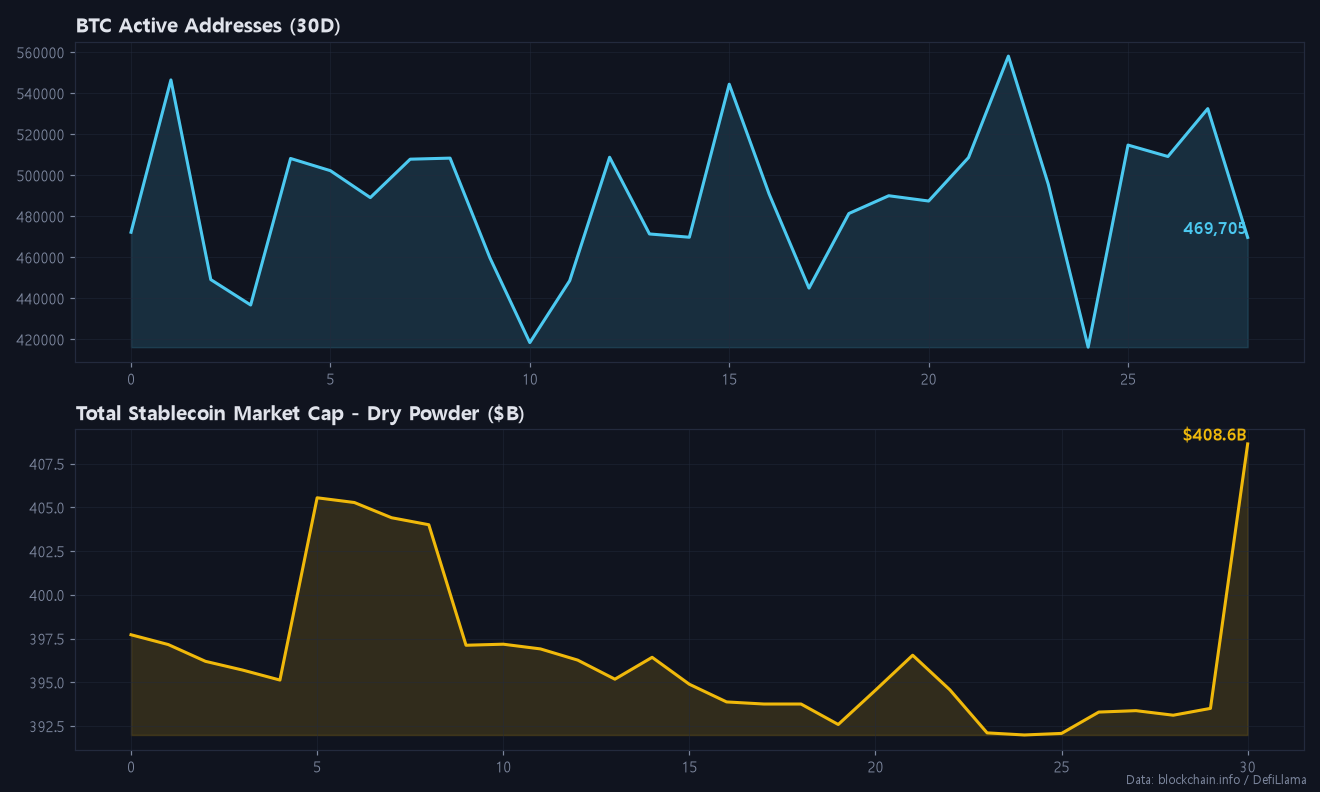
Network activity is soft but not collapsing. Bitcoin active addresses came in at 469,705 today, below the 7-day average of 499,439 and 3.7% under the 30-day mean. Transaction count was 573,988, down 1.1% against its 30-day average, and fast mempool fees are just 4 sat/vB, which signals little urgency to move coins. Hashrate stands at 904.8 EH/s, down 6.4% over 30 days, a sign that some miners are under margin pressure at these prices.
The constructive signal is liquidity. Total stablecoin market cap reached $408.6 billion, up $16.52 billion over seven days and $10.91 billion over 30 days, with most of the jump arriving in the latest reading. That is dry powder sitting on the sidelines. Reports that whales accumulated around 121,000 BTC, breaking the usual year-end selling pattern, point in the same direction. The on-chain chart below shows active addresses moving sideways while stablecoin supply steps higher.
How should investors judge politically linked crypto?
Here is my view: politically branded tokens should be valued at a steep discount to otherwise similar assets, regardless of who is in power. Political ties can bring early attention and access, but they also concentrate risk in a few people whose priorities are not token holders’ priorities. WLFI did not fall because a chart broke. It fell because governance, insider relationships and reputation all failed at once, and none of that showed up on a price chart beforehand.
A practical framework covers four questions:
- Who controls the supply? Check insider allocations, unlock schedules and whether the team can freeze or blacklist wallets.
- Who controls governance? If a few wallets decide every vote, the token is a membership pass, not a governance right.
- What happens if the politics change? Model the effect of elections, investigations or new rules on exchange listings and banking partners.
- Is the stablecoin separable? Reserves, custody and redemption rights should stand on their own, independent of the brand’s governance token.
Risk warning: with sentiment at extreme fear, crowded longs and rising yields, volatility can spike in either direction. Leverage can wipe out a position in minutes, and politically linked tokens can gap on headlines with no liquidity to exit. Size positions accordingly and always use stops.
FAQ
Why did WLFI fall 50%?
WLFI fell about 50% to record lows after Justin Sun publicly called for delisting, which reinforced existing doubts about the token’s governance and unlocks.
Is Bitcoin affected by the WLFI crash?
Only indirectly. Bitcoin is down 0.9% to $59,277 mainly because of record ETF outflows and a 4.94% 10-year yield, while WLFI added to extreme fear.
What is the key Bitcoin level to watch?
$57,500 is first support. With 74.9% of accounts long, a break could trigger liquidations toward $55,000, while $61,700 caps rebounds.
If you found today’s post helpful, please subscribe and like.
Real-time briefings and new-post alerts on Telegram: t.me/corecryptoinsights · Follow on X: @core_trading1
If you’ve been trading without a fee payback, you’ve been losing money this whole time — start getting your trading fees back today.
▶ Bitunix 70% fee payback — full sign-up guide
▶ BingX 45% fee payback — full sign-up guide
▶ BingX vs Bitunix — which saves you more?
Leave a Reply