Bitcoin is leaning bearish in the short term but stays structurally supported. BTC trades near $75,965. A 165k payrolls surprise lifted the dollar index 0.74%, ETF flows have stalled, and stablecoin supply fell $8.1B in 30 days. The White House’s 401(k) review is the main long-term bullish offset.

That is today’s tug-of-war in one line. Bitcoin has a slow-moving structural bid from retirement-plan access and a fast-moving cyclical headwind from macro, flows and liquidity. Below is the full ledger, scored line by line, followed by the levels and conditions that would flip it.
The Bull Case vs Bear Case Ledger
| Structural Tailwinds (Bull) | Cyclical Headwinds (Bear) |
|---|---|
| White House in final review of rules allowing BTC and ETH in U.S. 401(k) plans | October payrolls 165k vs 65k estimate, pushing back rate-cut hopes |
| Bitcoin dominance at 59.27%, showing institutions are concentrating in BTC | Dollar index ▲0.74% to 102.3 |
| Hashrate at 1,003 EH/s, up 9.4% over 30 days | Spot ETF flows stalled, with no dip-buying support |
| Active addresses 6.9% above their 30-day average | More than $1B in long liquidations |
| Fear & Greed at 25, historically a contrarian zone | Stablecoin supply -$8.1B over 30 days, down to $399.3B |
The two columns run on different clocks. Every item on the left builds over quarters. Every item on the right moves prices this week. Markets usually price the fast column first, and that is why Bitcoin is pinned near $76K despite a headline that, on paper, could open trillions of dollars in retirement savings to crypto.

Why is Bitcoin under pressure today?
Start with the jobs number. Payrolls came in at 165k against a 65k consensus, a miss of roughly 2.5x in the hawkish direction. A labor market that strong gives the Fed little reason to hurry with cuts. The 10-year Treasury yield sits at 4.86%, and the dollar index jumped 0.74% in one session. Gold fell 0.94% on the same move. That tells you this is a real-rates and dollar story, not risk aversion across the board.
Equities shrugged it off. The S&P 500 gained 0.31% to 7,376.86 and the Nasdaq added 1.09%. Crypto didn’t follow. Bitcoin is up just 0.75% on the day and down 1.57% on the week. When BTC lags a green Nasdaq, it usually means the marginal crypto buyer is missing, and the ETF data supports that read.
Spot ETF flows were the shock absorber through most of this cycle. Right now they aren’t absorbing anything. After more than $1B in long positions were liquidated, no steady wave of ETF inflows stepped in to buy the dip. Without that institutional bid, price discovery falls back to leveraged derivatives, and the derivatives picture is lopsided.
Futures sentiment: crowded longs in extreme fear
Funding is close to neutral at 0.0015%, so perpetual traders are not paying much to stay long. The positioning tells a different story. The long/short ratio stands at 3.07, with 75.4% of accounts net long. Open interest also rose 0.91% in 24 hours while the Fear & Greed Index slid from 28 to 25.
That combination matters. Fresh leverage is going into longs during extreme fear, which means bottom-fishers are adding exposure before a confirmed low. If $75K breaks, those positions become liquidation fuel.
Regulation: liquidity is migrating to compliant venues
Two enforcement headlines point the same way. The U.S. Treasury cut off MEXC over an alleged $16B in illicit flows. Separately, Thailand moved to block Bitget. Each action looks local. Together they describe a global reshuffling: order flow, market-making capital and user deposits are being pushed toward venues that can show clean compliance records.
In the short run this is mildly bearish for liquidity. Funds in transit between platforms aren’t funds bidding for coins, and offshore books can thin out during migration. Over the longer run it supports the bull column. The 401(k) story rests on the idea that crypto can fit inside regulated plumbing, and every enforcement action that squeezes grey-zone venues makes the regulated side of the market look more like the default.
Traders who move accounts during this shuffle should compare fee schedules as well as compliance. Taker fees on high-turnover strategies add up fast, and programs like the BingX fee payback on every trade or the Bitunix 70% fee payback sign-up guide directly lower the cost of each round trip. The fee-payback signup links are also listed at the end of this post.
On-chain data: dry powder is shrinking, the network isn’t
The on-chain picture splits along the same line as the ledger.
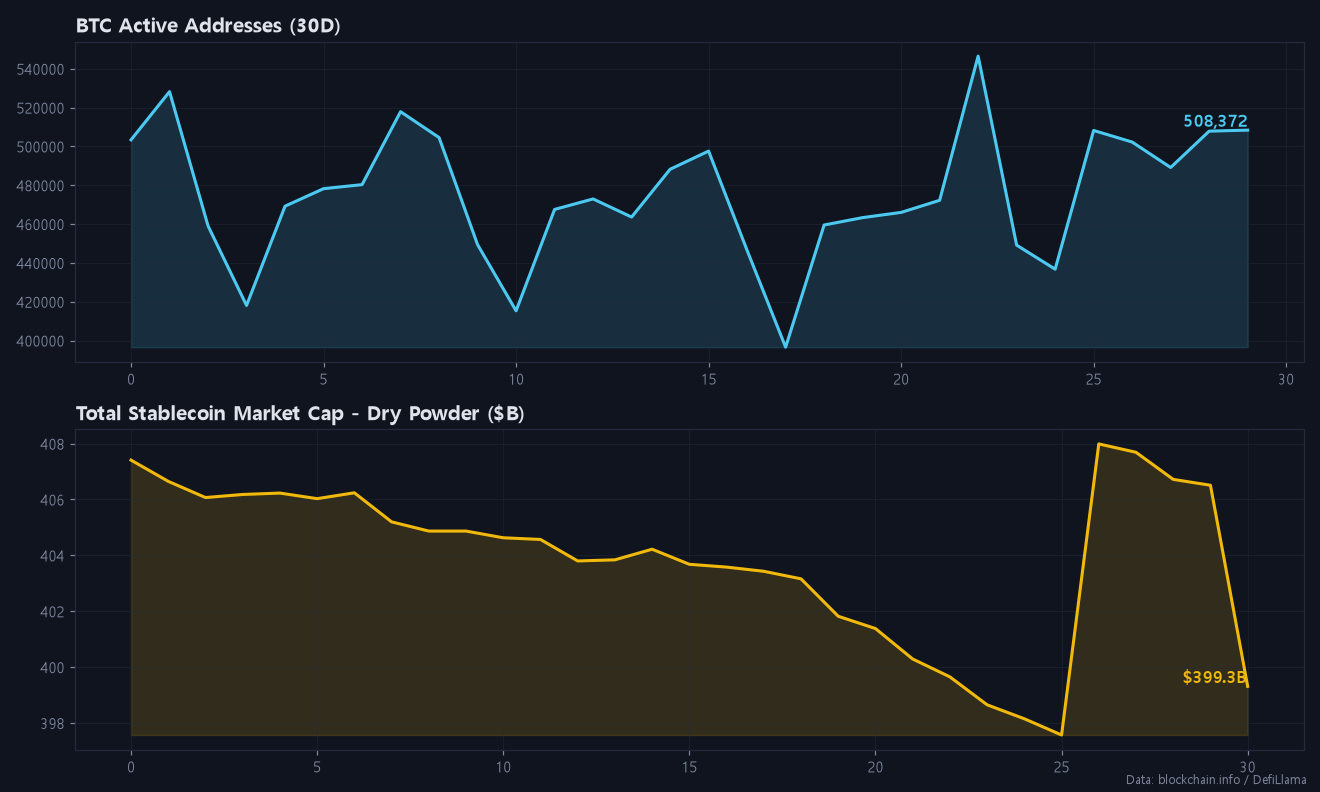
- Stablecoin market cap: $399.3B, down $8.1B over 30 days. The series started the month near $407.4B and drifted lower almost every day. It spiked briefly back above $407B and then fell to $399.31B in the latest reading. The 7-day change is slightly positive at +$0.66B, but the trend points down. Stablecoins are crypto’s on-chain cash, so a smaller pool means less ready capital to buy dips.
- Active addresses: 508,372 today versus a 7-day average of 485,955, or 6.9% above the 30-day average. Engagement is holding up and has climbed from lows near 396K earlier in the month.
- Transaction count: 414,323, which is 38.8% below the 30-day average. Fees in the mempool sit at just 2 sat/vB. Addresses are active, but they aren’t moving much value or competing for block space. That pattern looks like watching, not buying.
- Hashrate: 1,003 EH/s, up 9.4% in 30 days. Miners keep adding capacity at these prices, which signals confidence in the network’s long-term economics.
The chart below shows the split clearly. Network security and user presence are trending up, while stablecoin liquidity, the fuel for the next leg, is trending down.
What are today’s key Bitcoin support and resistance levels?
| Level | Type | Why it matters |
|---|---|---|
| $80,500 | Key resistance | A reclaim would break the post-payrolls structure |
| $78,000 | First resistance | Likely sell zone with a strong dollar |
| $75,000 | Psychological support | Line in the sand for crowded longs |
| $73,300–$73,700 | Secondary support | Next liquidity pocket below $75K |
| $58,000 | Extreme downside reference | Tail scenario if the Nasdaq rolls over hard |
The $58K figure has been circulating as a worst case tied to a deeper Nasdaq drawdown. It belongs on the map as a tail reference, not as a base case. Nothing in today’s funding or flow data points to that kind of unwind yet.
Trading scenarios: neutral to slightly short
Scenario A: short the bounce into resistance. With the dollar firm after the jobs surprise, rallies toward $78,000 look like better places to sell than to chase. Entry zone $77,600–$78,000, invalidation above $79,000, first target $75,000, extended target $73,500.
Scenario B: breakdown continuation. This is the higher-quality setup. Wait for a confirmed close below $75,000, then short a failed retest in the $74,800–$75,200 area. Stop at $76,300, target $73,300–$73,700, where crowded longs would likely be flushed.
Scenario C: bullish invalidation. If ETF flows turn positive and BTC reclaims $78,000 on volume, flip long on a hold above it. Stop at $76,500, target $80,500.
Here is my view. The 401(k) review is the most important crypto headline of the week, and the market is right to mostly ignore it for now. A rule in final review can still take months to reach plan menus, and then years before allocations turn into meaningful flows. Meanwhile, a 165k payrolls print and a shrinking stablecoin base are happening today. I’d stay patient on longs until the flow data confirms the narrative, and I’d see the 59.27% dominance reading as a reason to prefer BTC over alts in any recovery. XRP’s 6.24% weekly drop and Solana’s 5.96% slide show where the weak hands are.
Risk warning: with Fear & Greed at 25 and positioning this lopsided, short squeezes can be violent. Shorting directly into $75K support before a confirmed break risks getting caught in a sharp rebound. Size small, use hard stops, and treat leverage with caution.
What would flip the Bitcoin ledger to bullish?
- ETF net inflows turning positive for several consecutive sessions. This is the clearest sign the institutional bid has returned.
- Stablecoin supply reclaiming $405B. That would reverse most of the 30-day drain and refill on-chain dry powder.
- A firm 401(k) final ruling timeline. A published effective date would turn a vague narrative into a schedule that markets can price.
Two of these three would be enough to move the scorecard from neutral-bearish to neutral-bullish. Until then, the cyclical column has the upper hand.
FAQ
Is Bitcoin bullish or bearish right now?
Short-term bearish, long-term supported. BTC sits near $75,965 with the dollar index up 0.74%, while the 401(k) review and a 1,003 EH/s hashrate support the longer-term case.
Why did the jobs report hurt crypto?
October payrolls of 165k against a 65k estimate pushed back rate-cut hopes and lifted the 10-year yield to 4.86%. That strengthened the dollar and weighed on Bitcoin.
What is the key Bitcoin support level today?
$75,000 is the psychological line, with secondary support at $73,300–$73,700. First resistance is $78,000 and key resistance is $80,500.
If you found today’s post helpful, please subscribe and like.
Real-time briefings and new-post alerts on Telegram: t.me/corecryptoinsights · Follow on X: @core_trading1
If you’ve been trading without a fee payback, you’ve been losing money this whole time — start getting your trading fees back today.
▶ BingX 45% fee payback — full sign-up guide
▶ Bitunix 70% fee payback — full sign-up guide
▶ BingX vs Bitunix — which saves you more?
Leave a Reply