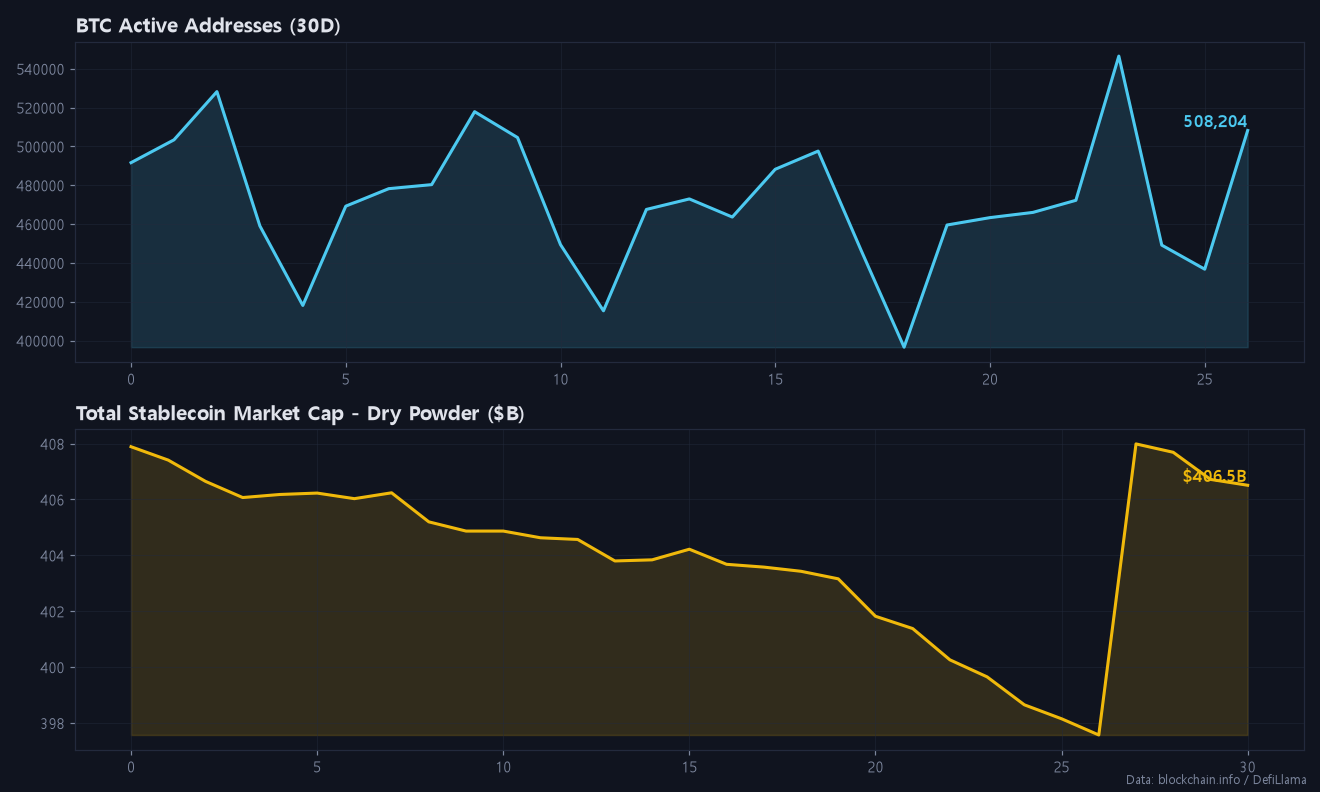
Bitcoin is down because new money is waiting instead of buying. BTC trades near $75,821, down 1.33% on the week. Stablecoin supply jumped about $10B in one day to $406.5B, yet ETF flows were flat and more than $1B of long bets were liquidated. Capital is parked, waiting for regulatory clarity from Washington.

The data points in two directions. One set suggests buyers are ready. The other suggests they are holding back. Bitcoin has spent the week pinned in a tight range while the Fear and Greed Index fell from 50 to 28. That fall is unusual for a market that barely moved on price. This piece follows the money, the policy changes and the macro backdrop to explain why dry powder is building without being spent.

Why are stablecoins rising while Bitcoin falls?
Start with the stablecoin series. Thirty days ago, total stablecoin market cap sat near $407.9B. Over the next four weeks it declined slowly, close to every day, to a low of $397.57B. That is roughly $10B of redemptions, which is what a cautious market looks like.
Then the trend broke. In a single session, supply jumped to $407.99B, a mint of about $10.4B. Since then it has eased slightly to $406.51B. On a 7-day basis that is a net gain of $6.86B. Over 30 days it is still down a small $1.37B. Stablecoins are minted when dollars enter crypto through regulated issuers, so this is new onshore dry powder, not capital rotating between tokens.
In a normal tape, a $10B mint during a pullback would show up as spot demand within days. That has not happened. Spot ETF flows gave no support, and more than $1B of bullish leveraged positions were wiped out. Prices held steady, the leveraged longs were flushed, and the new dollars stayed on the sidelines. This contradiction is the central story of the week.
On-chain: activity is up, conviction is not
The rest of the on-chain picture fits a market that is watching rather than committing:
- Active addresses: 508,204 today, 7.6% above the 30-day average and above the 7-day average of 477,448. Users are logging in and moving funds.
- Transaction count: 381,886, down 45.7% versus the 30-day average. Wallets are active, but they are making fewer and larger moves. That pattern suggests repositioning, not broad-based buying.
- Stablecoin market cap: $406.5B, up $6.86B week over week. This is the clearest dry-powder signal in the dataset.
- Hashrate: 936.7 EH/s, down 7.8% over 30 days. Miner caution matters here, given the policy risk to data centers and energy covered below.
- Mempool: fast fees at just 3 sat/vB, which confirms that block space demand is light.
Taken together, the chart below shows rising address activity alongside thin transaction volume and a stablecoin base that has just been refilled. Participants are positioned to act but are not acting yet.
What is Washington doing to crypto right now?
The trigger for the wait-and-see mood is political. Markets are repricing a Democratic “blue wave” sweep. That outcome scrambles assumptions that had supported the sector for most of the past year. Three policy areas are in question:
- Market-structure legislation: bills defining the line between commodities and securities now face a less predictable path. Institutions that need legal certainty before allocating are holding back.
- Data-center and energy policy: tighter rules on power-hungry computing would hit miners, power producers and chip suppliers. The 7.8% slide in hashrate looks less like noise in that light.
- Enforcement posture: this is already visible. Treasury cut off MEXC, a clear signal that offshore venues face tougher treatment. Separately, the CFTC is clashing with courts over prediction markets, which shows that even friendly regulators face legal friction.
TradFi gatekeepers are adding to the drag. Apple and Meta both rejected the OKX–ICE plan for tokenized stocks. Tokenized equities were supposed to be crypto’s next bridge into mainstream finance. When two of the largest names in the index refuse to take part, that expansion slows. Large allocators notice that kind of signal.
For an institutional desk, the message is simple: the rules are being rewritten. The sensible response is to hold dollars on-chain, where they can be deployed in seconds, rather than buy risk before the rules are known. That is exactly what the stablecoin data shows.
How do jobs data, the dollar and yields affect crypto?
Macro has removed any urgency. Payrolls came in at 165k against a 65k consensus, a large upside surprise that pushes back expectations for rate cuts. Markets reacted as expected:
- Dollar Index: 102.29, ▲0.73% on the day
- US 10-year yield: 4.86%, ▲0.45%
- Gold: $4,075.3, ▼0.93%
Equities are a useful contrast. The Nasdaq rose 1.09% and the S&P 500 gained 0.31%, yet crypto barely moved. When stocks rise and Bitcoin stays flat, the problem is specific to crypto: policy and positioning, not a broad risk-off move. A firmer dollar and a 10-year yield near 4.9% raise the opportunity cost of holding a non-yielding asset. That gives parked stablecoin capital little reason to rush.
What are today’s key BTC support and resistance levels?
Derivatives positioning is lopsided. Long accounts make up 75.6% of the total, the long/short ratio is 3.1, and open interest rose 2.15% while price went sideways. Funding at 0.01% is neutral, which means this leverage has not been cleared. Too many longs, a strong dollar and rising yields point to a tactical short bias. The goal would be a sweep of downside liquidations, not a breakdown in the broader trend.
| Asset | Level | Type | Note |
|---|---|---|---|
| BTC | $78,000 | Resistance 2 | Breakout target if $76k is reclaimed |
| BTC | $76,000 | Resistance 1 | Must be reclaimed first |
| BTC | $73,400–74,000 | Support | Main demand zone |
| BTC | $72,000 | Deeper support | Next level if the zone fails |
| ZEC | $1,400 / $1,500 | Resistance | Psychological levels |
| ZEC | $1,238 | Support | Pre-rally base |
Scenario 1: Leverage flush (base case)
This is a short setup on rallies into $75,600–76,000, with invalidation on a sustained move above $76,800. The first target is $74,000 and the second is $73,400. Take profits in the $73,400–74,000 zone. With roughly $10B of new stablecoins available, this is where dip buyers are most likely to step in.
Scenario 2: Sweep and reclaim
If price trades through $73,400 and quickly recovers, that is the long setup. Enter on the reclaim, set the stop below $71,800 (under $72k), and target $76,000 first and $78,000 second.
Scenario 3: Clarity breakout
A credible signal on market-structure legislation, or a softer enforcement tone, could release the parked capital all at once. In that case, a daily close above $76,000 opens a move toward $78,000. The short thesis is void in this scenario.
At these position sizes, execution costs add up, especially when trading a range back and forth. Many active traders cut them through programs like BingX’s 45% fee payback on every trade or the Bitunix 70% fee payback sign-up guide. Fee-payback signup links are also listed at the end of this post.
Zcash is the outlier. It is up 8.16% today, joins Dash among the top gainers, and now trades at $1,338.87. Privacy coins are drawing interest as enforcement tightens. Even so, $1,238 is the level to defend, and $1,400 is the first real test.
My view: parked, not departed
I read this tape as constructive beneath a nervous surface. Capital is not leaving crypto. If it were, stablecoins would be redeemed, not minted by $10B in a day. Allocators are holding cash on-chain and waiting for Washington to settle the rules. I expect regulatory clarity, not a lower price, to trigger deployment. Short-term weakness toward $73–74k should be met by that capital rather than accelerated by it.
Risk warning: if the Nasdaq reverses sharply, some analysts point to far lower Bitcoin targets. With a 3.1 long/short ratio, a break of $72k could set off a liquidation cascade that runs well past these levels. Size positions accordingly and always use stops.
Institutional catalyst watchlist
- Committee schedules and any statements on crypto market-structure bills
- Daily spot ETF flow prints: a turn to sustained inflows would confirm deployment
- Further Treasury or CFTC enforcement actions against offshore venues
- Data-center and energy policy proposals affecting miners
- DXY above 102.3 and the 10-year yield versus 5%
- Stablecoin supply: whether it holds above $406B or starts redeeming again
FAQ
Why is Bitcoin down today?
BTC is near $75,821, down 1.33% on the week. More than $1B in long liquidations, a 0.73% rise in the dollar and policy uncertainty after the election have kept buyers on the sidelines.
Is stablecoin growth bullish for crypto?
Over time, yes. Stablecoin supply rose $6.86B in seven days to $406.5B, which is dry powder that can be deployed once regulatory clarity arrives.
What is the key Bitcoin support level?
The main support is $73,400–74,000, with $72,000 below it. On the upside, $76,000 must be reclaimed before $78,000 comes into play.
If you found today’s post helpful, please subscribe and like.
Real-time briefings and new-post alerts on Telegram: t.me/corecryptoinsights · Follow on X: @core_trading1
If you’ve been trading without a fee payback, you’ve been losing money this whole time — start getting your trading fees back today.
▶ BingX 45% fee payback — full sign-up guide
▶ Bitunix 70% fee payback — full sign-up guide
▶ BingX vs Bitunix — which saves you more?
Leave a Reply