Bitcoin is falling today because sellers have pushed it to a three-month low near $64,937 (▼5.69% in 24h, ▼13.32% in 7 days) while derivatives have not yet flushed. Funding is still positive at +0.0025%, open interest is down only 0.58%, and a 5.15% US 10-year yield is pressuring risk assets.

Analysts now call this the “fourth capitulation wave” of the cycle. The Fear and Greed Index has dropped to 13 from 20 the day before, which is deep Extreme Fear. The derivatives market does not show that panic. Real capitulation usually happens when leveraged longs are forced out in a cascade. Today’s tape looks more like a slow grind in which longs keep paying to stay in. That gap between sentiment and positioning is the main story behind this Bitcoin move, and it raises a less obvious question: who is actually doing the selling?
Why Is Bitcoin Falling Today If Capitulation Isn’t Complete?
Start with leverage. A funding rate of +0.0025% is small, but it is still positive. That means perpetual longs are paying shorts to hold their positions, three months into a drawdown. Open interest slipped just 0.58% over 24 hours while spot fell almost 6%. In a true washout, those two numbers move together. Funding turns negative and OI drops by double digits as liquidation engines close positions.
Neither of those things has happened. The selling is coming from somewhere other than forced deleveraging. Altcoins are taking heavier losses: Ethereum is at $1,792 (▼8.02%), Solana at $70.74 (▼11.59%) and Hyperliquid ▼13.04%. Meanwhile Bitcoin dominance has firmed to 58.98%. That is a classic risk-reduction rotation. It is not a market-wide puke.

Supply Forensics: Thin Float, Heavy Overhang
Three supply storylines came together today. On their own, none of them explains a 13% weekly drop. Together, they describe a market where the tradable float is smaller than it looks, and where large latent holders can matter more than headline numbers suggest.
The 2011 wallet that woke up
A Satoshi-era wallet named in a reported $260 billion lawsuit moved 75 BTC that had been dormant since 2011. In dollar terms that is under $5 million, which the order books can absorb easily. The signal matters more than the size. When coins untouched for 15 years start moving during a drawdown, traders start pricing in the chance that more early-era supply follows. That expectation alone can thin bids.
The sovereign stash
Reports put US government holdings at 306,790 BTC, valued at roughly $20.5 billion. Washington has not signaled a sale. Still, this is policy-driven supply that does not respond to price. It responds to court orders, budget politics and administrative decisions. With headlines citing a “blue wave” shift rattling risk assets, the market is starting to discount the possibility that the policy stance on government-held Bitcoin could change.
The 18% that will never trade
Research estimates that up to 18% of Bitcoin’s supply is permanently lost. This is the multiplier. If a meaningful share of coins can never come to market, the effective float is smaller than the circulating figure implies. Any awakened or sovereign supply then hits a thinner pool of liquidity. Thin float plus heavy overhang is a combination that magnifies downside when demand steps back.
On-Chain Data: Fewer, Larger, Possibly Distributive Moves
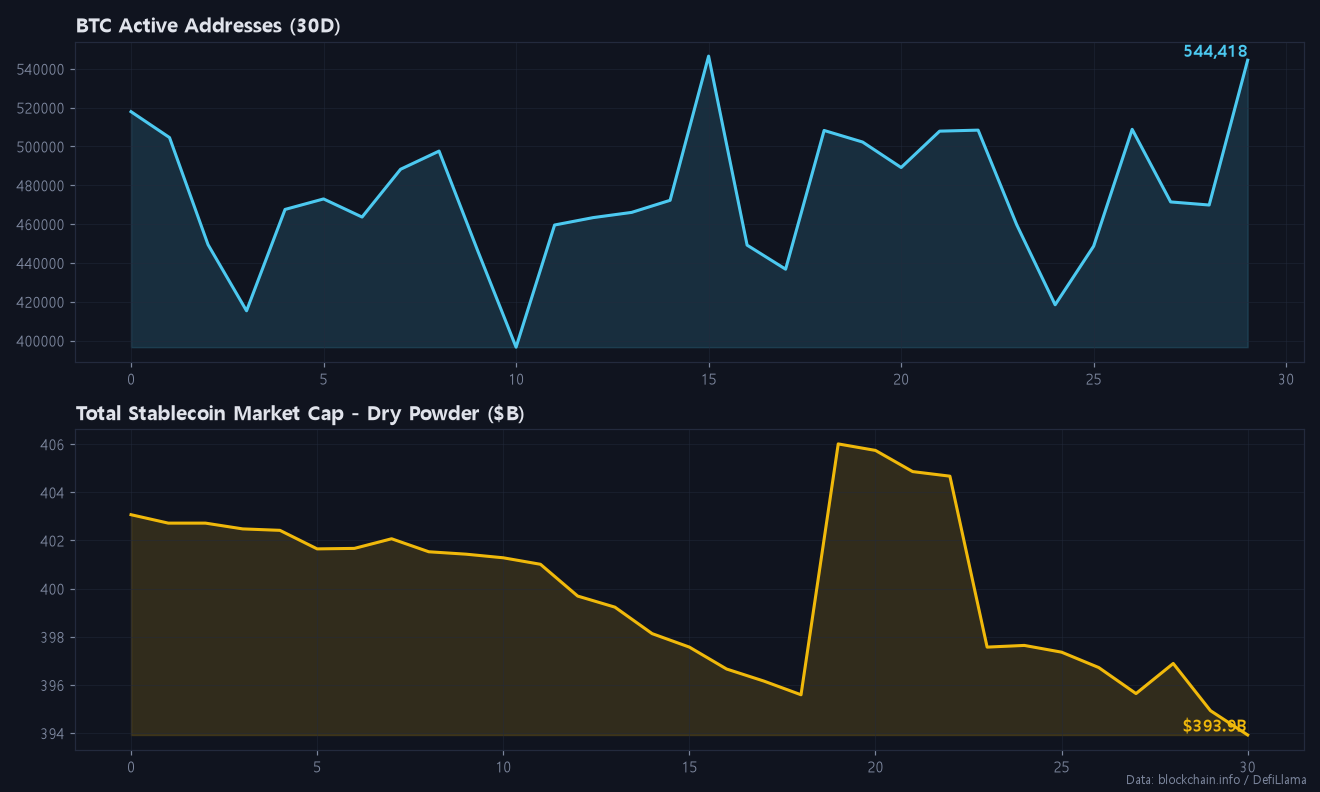
The on-chain picture adds a twist. Active addresses reached 544,418 today. That is about 14.6% above the 30-day average and well above the 7-day average of 474,451, and it is the highest reading in the past month apart from one spike. Transaction count tells the opposite story: 422,877 transactions, down 31.6% against the 30-day average. Mempool fast fees sit at just 1 sat/vB.
More addresses are touching the chain, but there are far fewer transactions and almost no fee competition. That does not look like a retail frenzy, which would clog the mempool and lift fees. It looks more like consolidation and repositioning: larger holders moving coins between wallets, possibly toward exchanges, in fewer and heavier transfers. This is not proof of distribution, but it fits that pattern better than accumulation does.
Two other datapoints matter. Hashrate stands at 833.4 EH/s, down 18% over 30 days. That suggests miner stress at these prices and raises the risk of miner selling to cover costs. A related headline notes that Paraguay will end Bitcoin mining power contracts in 2027 as AI data centers compete for energy. Stablecoin market cap, the market’s dry powder, has fallen to $393.9 billion, down $3.65 billion in a week and $9.15 billion over 30 days. Capital is leaving the system rather than waiting on the sidelines to buy the dip.
The chart above shows the divergence clearly. The active-address line rises into today’s reading while the stablecoin series trends lower through the month. Buying power is shrinking just as on-chain movement by larger wallets picks up.
How Is Macro Affecting Bitcoin Right Now?
Macro conditions are adding pressure. The US 10-year yield at 5.15% raises the opportunity cost of holding non-yielding assets. The Dollar Index firmed 0.23% to 103.41. The Nasdaq fell 0.91% and the S&P 500 slipped 0.4%. When high-beta tech sells off and the dollar strengthens, crypto rarely gets a pass, and institutional allocators tend to cut their most volatile exposures first.
Gold is close to flat at $3,886, so this is not a broad flight to hard assets. It is a rotation into cash and yield. Today’s small gainer list makes the point: yield-bearing dollar products such as Ondo’s USDY and Open USD are among the few tokens in the green.
What Are Today’s Key BTC Support Levels?
| Asset | Support | Resistance | 24h |
|---|---|---|---|
| BTC | 63.8k / 62k / 60k | 67.5k / 72k | ▼5.69% |
| SOL | $68 / $64 | $75 / $80 | ▼11.59% |
| ETH | n/a | n/a | ▼8.02% |
For Bitcoin, $63,800 is first support, followed by $62,000 and the psychological $60,000 level. The first overhead barrier is $67,500. The $72,000 zone, where the breakdown began, is the line that would change the structure.
Trading scenarios
- Primary (short on rallies): Sell bounces into BTC $67,000-68,000 and SOL near $75. Targets are BTC $63,800 then $62,000, and SOL $68 then $64. Invalidation is a daily close above $72,000 for BTC. For SOL, use a stop above $80.
- Alternative (capitulation long): Only consider this after funding turns negative and OI drops sharply. A wick into $60,000-62,000 followed by a reclaim of $63,800 would be the trigger, with a tight stop below the wick low and a first target at $67,500.
Trading costs matter in a choppy tape like this, because repeated entries and stops add up quickly. Fee-payback signup links are at the end of the post. If you trade perpetuals often, the BingX fee payback guide and the Bitunix referral sign-up guide explain how rebates reduce those costs.
What Does Real Bitcoin Capitulation Look Like?
Watch for this checklist before calling a bottom:
- Funding turns clearly negative and stays there for several sessions.
- Open interest falls more than 10% within 24-48 hours, a true leverage purge rather than today’s 0.58%.
- Fear-index divergence: price makes a lower low while the Fear and Greed Index stops falling from 13.
- Stablecoin market cap stops shrinking and turns higher, a sign that dry powder is returning.
- Mempool fees spike, which would signal panic transfers to exchanges.
My view: this is not capitulation yet. It is distribution into a thin float, made worse by macro pressure. Longs are still paying to hold, stablecoin liquidity is draining, and large wallets are active while retail is absent. Until funding flips and open interest breaks, I treat bounces toward $67,500 as selling opportunities, not new trends.
Risk warning: Extreme Fear readings can produce violent short squeezes, and a crowded short side can be wiped out within hours. Keep position sizes small, use hard stops, and respect the $72,000 invalidation. Nothing here is financial advice.
FAQ
Why is Bitcoin falling today?
BTC fell 5.69% to about $64,937 as rising yields (10Y at 5.15%), a firmer dollar and supply-overhang fears outweighed demand, while stablecoin supply shrank by $3.65 billion in a week.
Is Bitcoin capitulation over?
Probably not. Funding is still positive at +0.0025% and open interest fell only 0.58%, while true capitulation usually brings negative funding and an OI purge of more than 10%.
What is the next Bitcoin support level?
First support is $63,800, then $62,000 and $60,000. Resistance sits at $67,500 and $72,000.
If you found today’s post helpful, please subscribe and like.
Real-time briefings and new-post alerts on Telegram: t.me/corecryptoinsights · Follow on X: @core_trading1
If you’ve been trading without a fee payback, you’ve been losing money this whole time — start getting your trading fees back today.
▶ BingX 45% fee payback — full sign-up guide
▶ Bitunix 70% fee payback — full sign-up guide
▶ BingX vs Bitunix — which saves you more?
Leave a Reply