Bitcoin is falling because of a liquidity squeeze, not a crypto-specific failure. With the US 10-year yield at 5.15% and the Nasdaq down 0.91%, BTC trades near $64,526, down 13.06% on the week. Meanwhile, the largest options bet targets a break below $60,000, even as Coinbase wins a federal trust charter.

The paradox: record institutional plumbing, bearish options book
Look at two headlines from the same news cycle side by side. In the first, Coinbase secures a federal trust bank charter while already custodying more than 80% of spot Bitcoin ETF assets. That is about as clear a signal as you can get that the institutional rails for Bitcoin are maturing. In the second, the single largest open bet in the options market is a strike below $60,000, not a call at $100,000.
Both are true at once, and that tension is today’s story. Infrastructure adoption and price have decoupled in the short term. Custody, charters and ETF wrappers decide who can own Bitcoin. They do not decide whether those owners want more exposure this week. Right now, that decision is being made in the bond market.
The scoreboard backs this up. BTC is up only 0.15% in 24 hours after a 13.06% weekly drop. Ethereum is down 14.6% over seven days at $1,812, and Solana is off 17.7% at $71. The Fear and Greed Index sits at 10, extreme fear, for a second straight day. Bitcoin dominance at 59.31% shows capital hiding in the largest asset rather than leaving the market through altcoins alone. Recent reporting also points to continued spot ETF outflows. That is the clearest sign that the custody headline has not turned into fresh demand.
Why is Bitcoin falling when institutional adoption is growing?
Follow the transmission chain. The US 10-year Treasury yield has pushed to 5.15%, up 1% on the day. When the risk-free rate clears 5%, the hurdle for every risk asset rises at once. Equities feel it first. The Nasdaq fell 0.91% to 25,136 and the S&P 500 slipped 0.4% to 7,561.
The tell is gold. Normally gold catches a bid when risk assets wobble. Today it fell 0.79% to $3,855.70. When gold and Bitcoin get sold together, investors are not rotating between havens. They are raising cash. Both assets are liquid, both carry no yield, and both become funding sources when portfolio managers need to cover margin or rebalance into higher-yielding bonds.
The dollar index barely moved (103.44, +0.03%). So this is not a dollar-strength story. It is a rates story, specifically real yields competing with everything that pays nothing. Binance CEO Richard Teng described the sell-off as a normal reaction to macro uncertainty. CZ, for his part, listed six separate causes. Strip away the noise and most of those roads lead back to the same 5% yield.
The lame-duck Congress pushes the regulatory catalyst out
Many institutions were waiting for one more piece before scaling allocations: legislative clarity on market structure. Insiders now expect little to pass during the lame-duck session. That means the realistic window moves into the new Congress. For allocators who need a compliance green light, the regulatory catalyst has slipped by months, not weeks. A strong custody setup with no near-term policy trigger is exactly how you get excellent plumbing and soft prices together.
What is the derivatives market really saying?
The futures data points to de-risking by larger players while retail stays hopeful.
- Open interest -4.15% in 24h: leverage is being taken off the table, not added.
- Funding rate -0.0004%: only slightly negative, but a flip from positive means shorts are now paying to hold.
- Long/short ratio 2.79, with 73.6% of accounts long: the crowd is still positioned for a bounce.
This is the divergence that matters. If 73.6% of accounts are long while funding turns negative, the short side must be carried by fewer accounts with larger size. That profile fits hedging desks and funds, not retail. Add the options book leaning toward sub-$60K, and you have smart money buying protection while the account count stays long. Historically, that kind of retail long crowding tends to get flushed before a durable bottom forms.
What are today’s key Bitcoin support and resistance levels?
| Level | Role | Why it matters |
|---|---|---|
| $70,000 | Upper resistance | Round-number ceiling; reclaim would signal trend repair |
| $66,500 to $67,500 | Resistance zone | Former support flipped to resistance |
| $64,526 | Current price | Range midpoint, 24h → flat |
| $62,000 | First support | Recent flash-crash low |
| $60,000 | Psychological support | Largest options open interest strike |
As the chart shows, Bitcoin is sitting inside a range between the $62,000 crash low and the $66,500 to $67,500 band that held as support before the breakdown. Price has gone flat over 24 hours after the slide, which looks more like exhaustion than accumulation. Open interest is shrinking into the range and funding is hovering just below zero.

On-chain data: usage is mixed, dry powder is draining
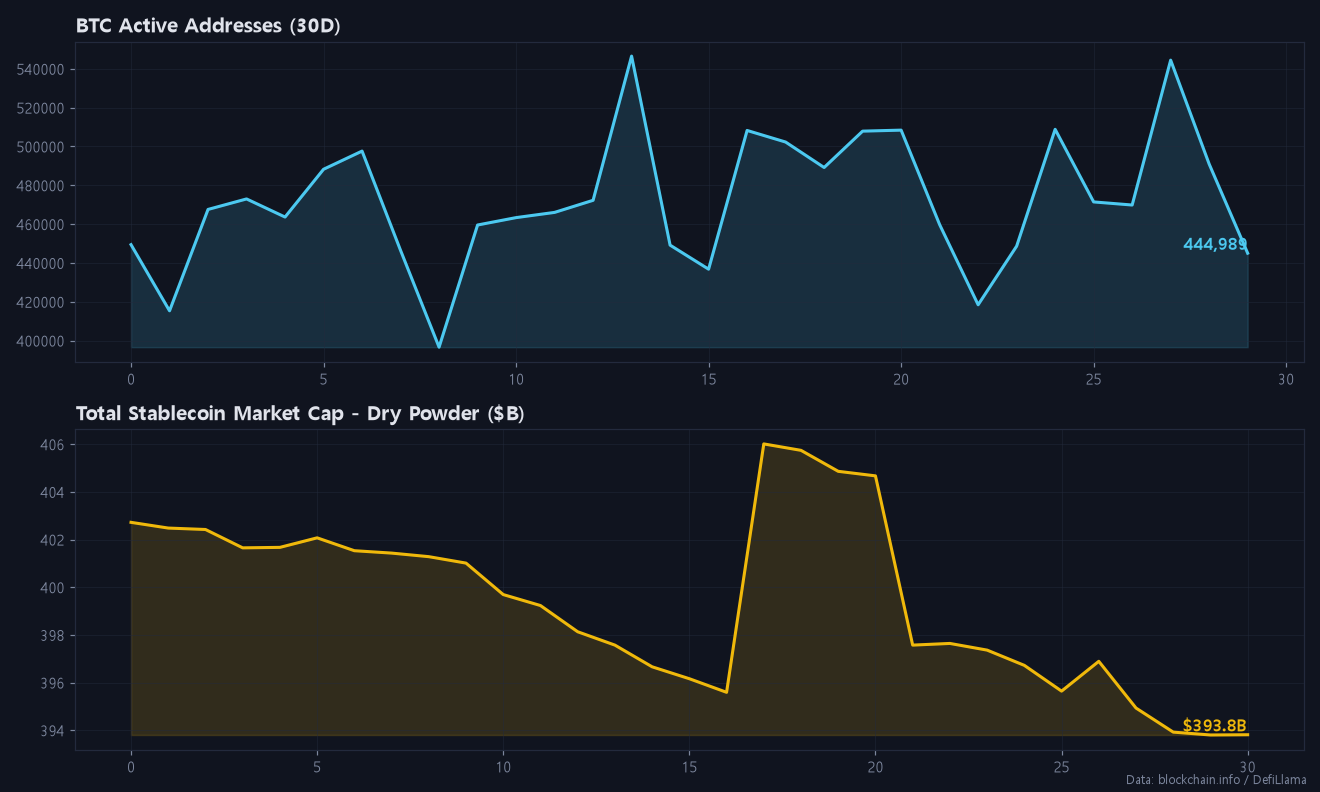
On-chain metrics add nuance to the bearish tape. Active addresses printed 444,989 today, below the seven-day average of 482,702 and 5.7% under the 30-day average. Participation is cooling. Transaction count, however, jumped to 963,618, 55.8% above its 30-day average. With the mempool fast fee at just 1 sat/vB, that spike points to cheap transfers and repositioning, possibly exchange movements, rather than congestion-driven demand.
The more important number is stablecoin supply. Total stablecoin market cap fell to $393.8 billion, down $3.55 billion in seven days and $8.91 billion over 30 days. Stablecoins are the market’s dry powder. When that pile shrinks during a drawdown, buyers are leaving the arena instead of waiting on the sidelines. That fits the liquidity-squeeze thesis neatly.
Miners are the one clear bright spot. Hashrate reached 1,152.8 EH/s, up 20.4% in 30 days. Network security keeps compounding regardless of price, which is another example of fundamentals and price moving on different clocks. The on-chain chart below shows the stablecoin decline against the choppy active-address trend.
My view: the floor is set by yields, not headlines
My stance is neutral to mildly bearish. I do not think the Coinbase charter is irrelevant. It is a long-term positive that will matter when liquidity returns. But I would not buy Bitcoin on institutional headlines while the 10-year sits above 5% and stablecoin supply is falling. The market is telling us that macro sets the floor right now. Until the retail long crowd at 73.6% thins out, I expect rallies into resistance to be sold.

Bitcoin trading scenarios for this week
Primary: sell the rally (mild short bias)
- Entry: scale into shorts between $66,500 and $67,500
- Stop: daily close above $68,000
- Targets: $64,500 first, then $62,000
Respect the stop. Funding has flipped negative, so a crowded short side can be squeezed quickly if yields ease.
Secondary: long only after confirmation
- Entry: on a confirmed hold at $62,000 and a falling long-account ratio
- Stop: below $60,000
- Targets: $66,500, then $70,000 if macro turns
A clean break below $60,000 would trigger the options-heavy zone. In that case, dealer hedging could accelerate the move before any recovery.
Scaling in and out across several entries adds up in costs, so fee-payback signup links are at the end of the post. If you trade often, a BingX referral code with 45% fee payback or the Bitunix 70% fee payback sign-up guide can lower the cost of active range trading.
What would flip the bias bullish?
Watch macro first and crypto second. Three triggers would change my view:
- The 10-year yield falls back below 5% and holds there ▼
- The Nasdaq reclaims its pre-sell-off level and gold stops falling with risk assets
- Stablecoin market cap turns higher, which would show dry powder returning ▲
If all three line up while Bitcoin holds $62,000, the $66,500 to $67,500 band becomes a breakout candidate rather than a short zone.
Risk warning: extreme fear readings like today’s 10 can produce violent short squeezes, especially with funding negative. Leverage in a thin, macro-driven market can wipe out positions on a single headline. Size small and always use stops.
FAQ
Why is Bitcoin down this week?
Bitcoin is down 13.06% in seven days mainly because the US 10-year yield rose to 5.15%. That pressured the Nasdaq and pushed investors to sell liquid assets like BTC and gold.
What is the key Bitcoin support level today?
First support is $62,000, the recent crash low. Below that, $60,000 is the psychological level where the largest options bet sits.
Are traders still bullish on Bitcoin?
Retail is: 73.6% of accounts are long. However, open interest fell 4.15% and funding turned negative at -0.0004%, which suggests larger players are hedging.
If you found today’s post helpful, please subscribe and like.
Real-time briefings and new-post alerts on Telegram: t.me/corecryptoinsights · Follow on X: @core_trading1
If you’ve been trading without a fee payback, you’ve been losing money this whole time — start getting your trading fees back today.
▶ BingX 45% fee payback — full sign-up guide
▶ Bitunix 70% fee payback — full sign-up guide
▶ BingX vs Bitunix — which saves you more?
Leave a Reply