Bitcoin is lagging because institutional demand is thinning while macro conditions are moving against it. The Nasdaq rose 6.51% and gold gained 3.39%, yet BTC added only 0.55% to $61,304 and is still down 5.88% on the week. Rising yields at 4.92%, a firmer dollar and fresh compliance headlines are keeping cautious capital away.

Trader’s diary, today. I opened my screens expecting the kind of session where everything lifts together. The Nasdaq ripped, the S&P followed, gold caught a strong bid. Then I looked at Bitcoin. Barely green, and nowhere near its starting price for the week. So the question I wrote at the top of my notebook was simple: on a day when every asset went up, why did Bitcoin sit it out?
Why is Bitcoin not rising with stocks today?
Start with the scorecard. Decoupling is easy to claim and harder to show, so here are the numbers side by side.
| Asset | Last | 1-Day Change |
|---|---|---|
| Nasdaq | 24,089.56 | ▲ 6.51% |
| S&P 500 | 7,237.17 | ▲ 4.73% |
| Gold | 3,634.70 | ▲ 3.39% |
| US 10-Year Yield | 4.92% | ▲ 0.12 |
| Dollar Index (DXY) | 104.32 | ▲ 0.49% |
| BTC | $61,304 | ▲ 0.55% (7d ▼ 5.88%) |
| ETH | $1,719.85 | ▼ 0.31% (7d ▼ 5.44%) |
A 6.5% move in the Nasdaq is a big risk-on signal. Gold rallying alongside it tells you that both growth appetite and hedging demand were active. Crypto got neither. BTC dominance sits at 58.01%, so this wasn’t a rotation into altcoins either. Solana added 3.04% and a handful of names like Quant (+11.21%) and Algorand (+8.29%) moved, but those are isolated pockets rather than a broad bid.
I came up with three hypotheses. Here is how each one holds up.

Hypothesis 1: Is institutional demand for crypto products fading?
The quietest headline of the week may be the most telling. ARK Invest pulled two planned crypto ETFs. Issuers don’t shelve products they think will gather assets. They shelve them when conversations with allocators come back lukewarm. That isn’t a crash signal, but it is a demand signal, and it points the wrong way.
Commentary arguing that Bitcoin’s five-year return is near zero and that its big narratives are wearing thin fits the same picture. Strip away the digital-gold and adoption stories and you are left mainly with a liquidity trade. Liquidity trades need fresh money coming in. Right now, the evidence says it isn’t.
Verdict: supported. When product launches are being pulled rather than filed, allocator appetite is soft.
Hypothesis 2: Are rising yields and a stronger dollar hurting Bitcoin?
This one carries the most weight. The 10-year Treasury yield climbed to 4.92% and the dollar index firmed to 104.32. For a non-yielding asset, that combination is a headwind. Every basis point added to a risk-free yield raises the opportunity cost of holding something that pays nothing.
Equities can shrug that off when earnings growth is strong enough, and AI-led tech returning ‘with a bang’ gives them a story to do it. Gold can shrug it off when hedging demand is high. Bitcoin has neither an earnings stream nor, at this moment, a hedging bid. It sits in the gap. That is why the same macro tape that lifted the Nasdaq did almost nothing for BTC.
Verdict: strongly supported. Rising real-rate pressure plus a firmer dollar is the cleanest explanation for the lag.
Hypothesis 3: Is regulatory and hack risk keeping cautious capital away?
The compliance overhang keeps growing. US authorities are seeking to recover $1.1B tied to the North Korea-linked Binance hack. Separately, hackers are laundering $247M through obfuscating transactions. Add the reports of crypto thieves infecting iPhones through online ads with a single tap, and the week’s newsflow reads more like a risk-committee memo than a sales pitch.
Even the more constructive angle, with the US and UK reportedly holding seized bitcoin as a strategic reserve rather than selling it, doesn’t change the near-term picture. Compliance officers at pension funds and RIAs read the hack headlines first.
Verdict: partially supported. This isn’t what knocked BTC down today, but it is a reason the money that left isn’t hurrying back.
What does on-chain data say about Bitcoin demand?
The chain tells a mixed story, but the parts that matter for price lean cautious.
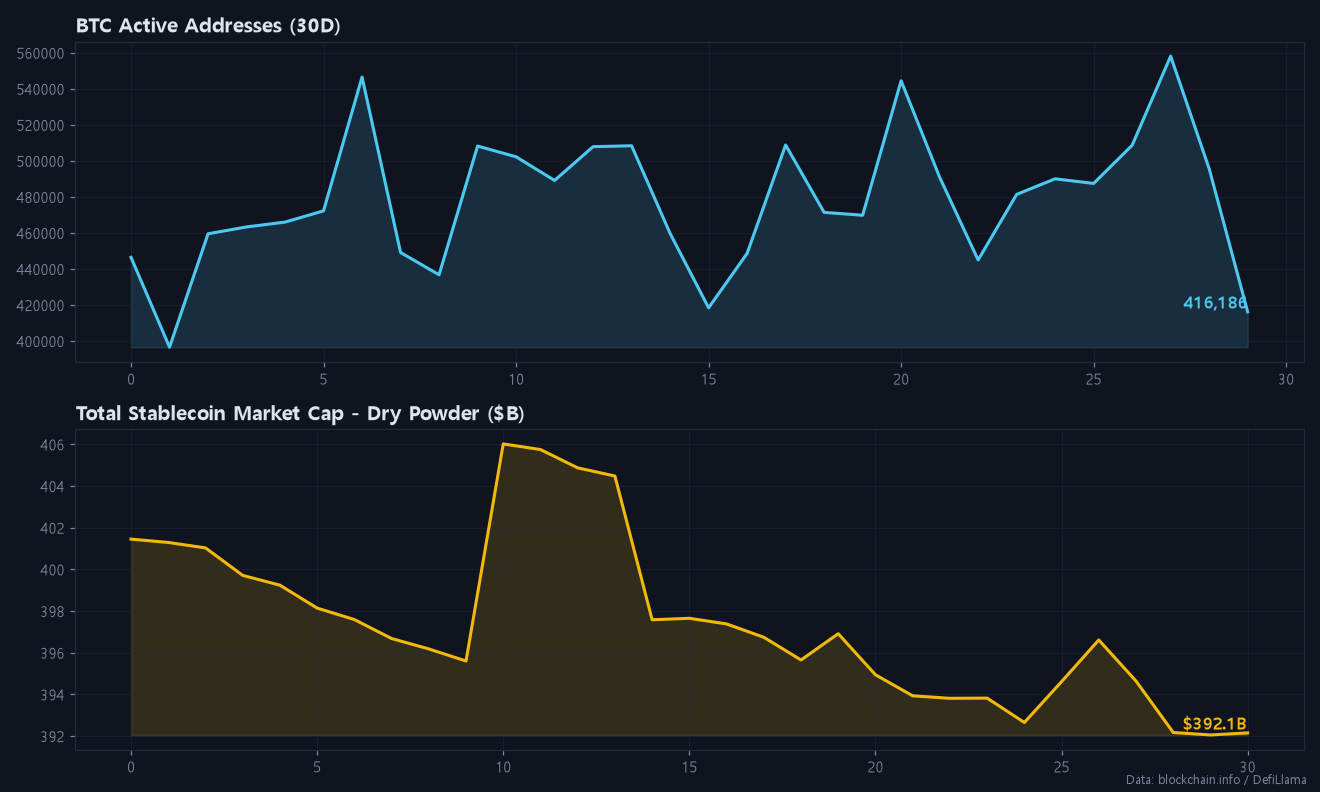
- Active addresses: 416,186 today against a 7-day average of 491,062, and 13% below the 30-day average. That is one of the lowest prints in the recent window, down from 558,122 just two sessions ago.
- Transaction count: 716,530, up 17.6% versus the 30-day average. Fewer participants are moving more transactions, which looks more like repositioning by existing holders than new users arriving.
- Stablecoin market cap: $392.1B, down $1.68B over seven days and $9.3B over thirty. This is the dry powder that usually funds crypto rallies, and it is shrinking rather than building.
- Hashrate: 1,065.6 EH/s, up 4.4% over 30 days. Miners aren’t capitulating, so the network side is healthy.
- Mempool: fast fee at 1 sat/vB, a sign of very light blockspace demand.
As the on-chain chart below shows, the stablecoin line has drifted lower for a month while active addresses rolled over this week. Shrinking dry powder plus thinning participation is not the setup that starts a sustained rally.
What are today’s key BTC support and resistance levels?
- $60,000: psychological support and the line that matters most this week
- $58,000: secondary support
- $55,300: recent swing low
- $63,500: first resistance
- $65,000: major resistance, close to the weekly open
Futures positioning: extreme fear, but crowded longs
This is the part I keep circling. The Fear & Greed Index reads 11, Extreme Fear, unchanged from yesterday. In theory, that is contrarian buy territory. But the derivatives book doesn’t look fearful at all. Long accounts make up 72.6% of positions, a long/short ratio of 2.65, and funding is still positive at +0.0065%, so longs are paying to hold. Open interest slipped 0.48%, which means no new money is entering on either side.
Sentiment is scared, but positioning is still hopeful. Real bottoms usually come when the crowd is short and paying for it. We are not there yet, and that mismatch leaves room for a flush that shakes out late longs.
My take: no position today
Here is my honest stance. I’m flat, with a neutral-to-slightly-bearish lean. Bitcoin failing to follow a 6.5% Nasdaq surge is information, not noise. When an asset can’t rally on the best risk-on day in weeks, the burden of proof sits with the bulls. I would rather miss the first 5% of a genuine turn than spend capital fighting yields at 4.92% with crowded longs still paying funding.
If I trade at all, these are the scenarios I’ve written down:
- Short scenario (preferred, small size): fade a bounce into $63,500-$65,000. Invalidation on a daily close above $65,800. Targets $60,000, then $58,000. No aggressive shorts below $60k until a breakdown is confirmed, because chasing into extreme fear is how shorts get squeezed.
- Long scenario (conditional): only after BTC reclaims $65,000 on rising volume, entering on a retest of $64,000-$65,000 with a stop under $62,800 and a target of $68,000. A second, riskier option is a capitulation wick toward $55,300 with funding flipping negative, stop under $54,000.
Small-size, range-bound trading also means fees eat a bigger share of each trade’s edge. If you trade often, look at fee rebates through options like the BingX referral code with 45% fee payback or the Bitunix 70% fee payback sign-up guide. Fee-payback signup links are also collected at the end of this post.
Risk warning: extreme fear readings can reverse violently. With 72.6% of accounts long, a drop below $60,000 could trigger cascading liquidations toward $58,000 or lower. A sudden macro relief, such as yields dropping sharply, could squeeze shorts just as fast. Size small and always use stops.
What would make me re-enter?
The checklist taped to my monitor:
- Spot ETF flows turning consistently positive for several sessions
- The 10-year yield cooling back below 4.75% and DXY easing under 104
- BTC reclaiming $65,000 on expanding volume, not a thin weekend drift
- Stablecoin market cap rising again from $392.1B
- Funding turning flat or negative while price holds $60k, a sign that late longs have been cleared
Two or three of these lining up would be enough to flip me from observer back to participant. Until then, sitting out the party is the trade.
FAQ
Why did Bitcoin barely move when the Nasdaq jumped 6.51%?
The 10-year yield rose to 4.92% and the dollar firmed to 104.32, which hurts non-yielding assets, while institutional product demand is thinning. BTC managed only +0.55% to $61,304.
What is the key Bitcoin support level right now?
$60,000 is the main psychological support, followed by $58,000 and the recent low at $55,300. Resistance sits at $63,500 and $65,000.
Is extreme fear a signal to buy Bitcoin?
Not on its own. The Fear & Greed Index is at 11, but 72.6% of futures accounts are still long with positive funding, so positioning hasn’t fully reset.
If you found today’s post helpful, please subscribe and like.
Real-time briefings and new-post alerts on Telegram: t.me/corecryptoinsights · Follow on X: @core_trading1
If you’ve been trading without a fee payback, you’ve been losing money this whole time — start getting your trading fees back today.
▶ BingX 45% fee payback — full sign-up guide
▶ Bitunix 70% fee payback — full sign-up guide
▶ BingX vs Bitunix — which saves you more?
Leave a Reply