Wall Street is pushing back on crypto tokenization because incumbents want to keep control of distribution and fees. Apple and Meta reportedly rejected the OKX–ICE tokenized stock plans. Meanwhile, $1.3B left spot ETFs, the 10-year yield sits at 4.86%, and Bitcoin trades near $75,588 with sentiment at Extreme Fear (25).

The paradox: a tokenized HELOC in the top 10
The crypto top 10 is supposed to reflect where the asset class has momentum. Today, the ninth-largest asset by market cap is not a layer-1 chain or a meme coin. It is Figure HELOC, a tokenized home-equity credit product priced at $1.032, up 1.02% on the week. It ranks just above Zcash, which fell 7.14% in 24 hours to $1,243.79.
Consider what that means. A product backed by American homeowners’ credit lines now outranks one of crypto’s oldest privacy coins. In the same week, two of the largest technology companies in the world reportedly declined to have their shares tokenized through the OKX–ICE initiative. Tokenized real-world assets are clearly scaling. Getting the owners of the underlying assets to cooperate is a separate problem, and a harder one.
CoinDesk summed up the industry’s challenge: finding growth is one thing, and monetizing it is another. Across RWA tokenization, tokenized equities and prediction markets, crypto has found new growth engines. What it has not secured is the right to distribute them freely.

Front one: big-tech gatekeepers and the OKX–ICE plan
The OKX–ICE partnership was meant to show how tokenized equities could connect a crypto-native exchange with the plumbing of a traditional market operator. Apple and Meta’s reported rejection shows the limit of that model. An issuer that never consented to its shares being wrapped can push back on the brand, the disclosure and the economics.
The economic motive is simple. Whoever controls the token wrapper controls the fee stream, the user relationship and the data. Large issuers have little reason to hand that to a third party, especially one operating around the clock under looser rules than a listed venue. Expect future tokenized-equity products to lean toward issuer-sanctioned or incumbent-run structures rather than permissionless wrappers.
Front two: regulators versus the courts, and Thailand versus Bitget
Prediction markets have been one of the clearest crypto-adjacent growth stories of the cycle. That is why the CFTC’s latest demand matters. It sits in direct tension with recent court rulings that had widened the space for event contracts. When an agency and the judiciary pull in opposite directions, the practical result is legal uncertainty. Uncertainty is what institutional compliance teams are paid to avoid.
In Asia, Thailand’s move to block Bitget follows the same logic. Regulators are not necessarily against the products. They want offshore platforms to come through local licensing channels or stay out. For global exchanges, the cost of reaching new users is now a regulatory cost first and a marketing cost second.
Front three: exchange distribution gets squeezed
Binance’s notice to European users about fees and account closures fits the same pattern from the opposite direction. Even the largest crypto venue is reshaping how it serves a major region as MiCA-era rules settle in. Products are expanding, but the channels that deliver them to retail users are narrowing, getting more expensive, or both.
For active traders, that pressure appears as fees, spreads and withdrawal frictions. Those costs compound quickly at current volatility. Fee-payback signup links are at the end of this post. If you want to compare options now, the BingX fee payback guide for 2026 and the Bitunix referral code and 70% fee rebate walkthrough explain how the rebates work.
Why are crypto ETFs seeing outflows right now?
The macro backdrop explains much of the caution. The US 10-year yield rose to 4.86%. The dollar index gained 0.74% to 102.3. Gold slipped 0.94%. Spot crypto ETFs saw about $1.3B in outflows. Equities sent mixed signals: the Nasdaq closed up 1.09% and the S&P 500 rose 0.31%, after an earlier tech sell-off had briefly pushed Bitcoin below $76,000.
When yields and the dollar rise together, holding non-yielding assets costs more. Allocators who added Bitcoin exposure through ETFs for portfolio diversification are cutting risk rather than buying the narrative. Bitcoin dominance at 59.34% confirms the defensive posture. Money that stays in crypto is concentrating in BTC, while XRP (-7.72% weekly) and Solana (-7.14% weekly) lag.
What does on-chain data say about crypto demand?
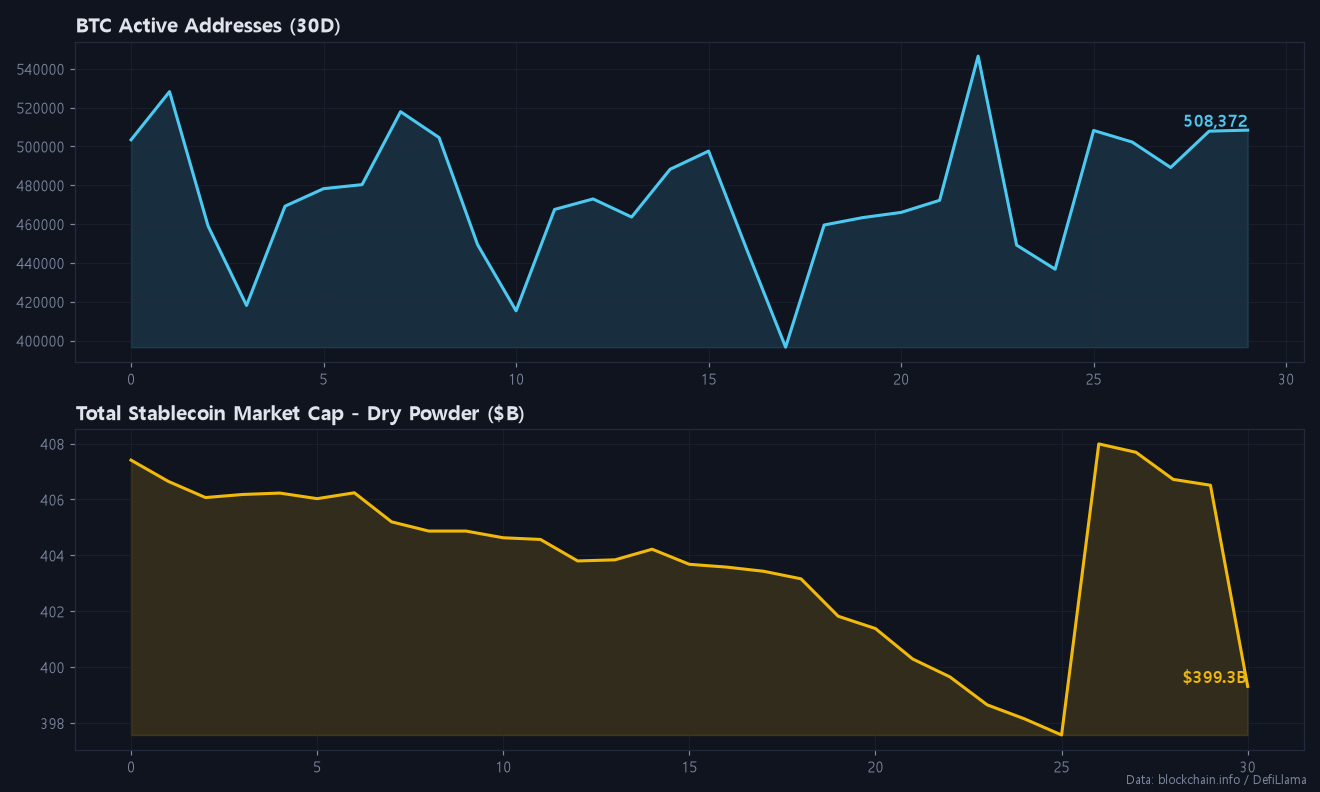
Network data looks healthier than price action and sentiment. Bitcoin active addresses reached 508,372 today. That is above the seven-day average of 485,955 and 6.9% above the 30-day average. Over the past month, the series moved roughly between 397k and 547k, and the latest readings sit in the upper half of that range.
Transaction count tells a different story. At 414,323, it is 38.8% below its 30-day average, and the fast mempool fee is just 1 sat/vB. More addresses are active, but they are moving less. That fits holders repositioning or watching rather than heavy speculative churn.
Stablecoins, crypto’s dry powder, are the key variable. Total stablecoin market cap stands at $399.3B. That is up $0.66B over seven days but down $8.1B over 30 days, after a brief spike above $407B faded. Sidelined capital has been leaving the ecosystem rather than waiting at the edge of it. On the supply side, hashrate reached 1,003 EH/s, up 9.4% in 30 days, so miners remain committed even as some, such as Core Scientific, shift capacity toward AI data centers. The chart below shows these trends together.
What are today’s key Bitcoin support levels?
A short sidebar on price, since this is not a price story. Bitcoin sits at $75,588 (▼0.29% on the day, ▼2.51% on the week). First support is $74,000, and the core support zone is $72,000–$73,200. A clean break below the range floor opens a scenario toward the $60,000s, which some analysts have flagged. On the upside, the first test is reclaiming $76,000, followed by $78,000.
| Metric | Level / Reading | Signal |
|---|---|---|
| BTC resistance | $76,000 → $78,000 | Short-entry zone on bounces |
| BTC first support | $74,000 | Break risks long liquidations |
| BTC core support | $72,000–$73,200 | Range floor; below it, $60k-range risk |
| Long account share | 75.3% (L/S 3.06) | Crowded retail longs |
| Funding rate | 0.0052% | Not overheated |
| Open interest (24h) | -0.4% | No fresh buying |
Futures positioning supports a neutral-to-bearish bias. Funding of 0.0052% is benign, but 75.3% of accounts are long with no new open interest behind them. That leaves a crowd of retail longs with no fresh buyers. Short scenario: sell bounces into $76,000–$78,000, invalidate above roughly $78,800, and target $74,000 then $73,200. Long scenario: only a defensive bid near $72,000–$73,200 with a stop below $71,500, targeting $75,500–$76,000. With the Fear and Greed Index at 25, a contrarian squeeze is possible, so keep stops on shorts tight.
Is tokenization a real bid for crypto or a balance-sheet story?
My view: tokenization is real, but most of its value will not flow to crypto tokens. Figure HELOC’s top-10 ranking reflects issuance size, not organic demand for BTC or ETH. Apple and Meta show that issuers will defend their economics. The CFTC shows regulators will defend their jurisdiction. Binance’s EU changes show that even the biggest crypto distributors must pay to stay in the market. In the near term, I expect incumbents such as exchanges, transfer agents and licensed issuers to capture most tokenization fees. Crypto-native firms will mainly earn infrastructure-level margins.
For institutional allocators, the outflows make sense. Tokenization headlines are not yet a reason to own the asset class. The next adoption leg probably needs one of two catalysts. One is a regulatory settlement on prediction markets and tokenized securities. The other is a clear case of a crypto-native platform keeping meaningful economics from a tokenized product. Until then, rates and the dollar drive flows more than narratives do.
Risk warning: With 75.3% of accounts long and yields at 4.86%, a break of $74,000 could trigger a cascade of long liquidations toward the $72,000 zone or lower. Size positions so that being wrong is survivable.
FAQ
Why is Figure HELOC in the crypto top 10?
Figure HELOC is a tokenized home-equity credit product whose large issued supply gives it the #9 market cap rank at $1.032, above Zcash. Its rank reflects issuance size more than speculative demand.
Why did crypto ETFs see outflows today?
About $1.3B left spot ETFs as the US 10-year yield rose to 4.86% and the dollar index gained 0.74%, which pushed allocators toward lower risk.
What is the key Bitcoin support level right now?
First support is $74,000, and the core range floor is $72,000–$73,200. A break below that zone opens a downside scenario toward the $60,000s.
If you found today’s post helpful, please subscribe and like.
Real-time briefings and new-post alerts on Telegram: t.me/corecryptoinsights · Follow on X: @core_trading1
If you’ve been trading without a fee payback, you’ve been losing money this whole time — start getting your trading fees back today.
▶ BingX 45% fee payback — full sign-up guide
▶ Bitunix 70% fee payback — full sign-up guide
▶ BingX vs Bitunix — which saves you more?
Leave a Reply