Bitcoin is falling today because risk capital is rotating toward AI mega-IPOs while US yields stay punishing. BTC trades near $63,972, down about 13% in seven days. The Fear & Greed Index sits at 12, and the 10-year Treasury yield near 5.1% is capping any recovery attempt.

Today’s crypto market in three lines
- Bitcoin -12.97% week-over-week to roughly $63,972, with sentiment pinned at Extreme Fear (12, up from 10 yesterday).
- The capital-rotation thesis: VanEck attributes part of the slide to the Anthropic IPO absorbing speculative liquidity and flags a possible early-December bottom.
- The binding constraint: a US 10-year yield near 5.1% raises the opportunity cost of holding non-yielding risk assets, and crypto is paying the bill.
This drawdown is not a crypto-native collapse. No major exchange has failed, no stablecoin has depegged, and leverage is not blowing out. What we are seeing looks more like a portfolio decision. Allocators with a fixed risk budget are choosing between a hot AI equity listing and a crypto position, and for now the IPO is winning.
Why is Bitcoin falling while AI stocks get the money?
For most of the past cycle, investors treated AI equities and Bitcoin as complementary bets on the same speculative appetite. That relationship has flipped. A mega-IPO like Anthropic’s needs to absorb billions of dollars of fresh demand, and that money has to come from somewhere. VanEck’s argument is that a meaningful share came out of liquid, high-beta holdings such as BTC, which can be sold at any hour without moving the order book much.
The equity tape backs this up. The S&P 500 fell 1.03% to 7,340.53 and the Nasdaq slipped 0.74%. So this was not a clean rotation into tech either. Broad risk is being repriced, and crypto, as the most liquid high-beta asset class, is absorbing the selling first. The hope among some traders that AI weakness would push money back into Bitcoin has not played out.
Stanley Druckenmiller’s reported copper short and his warning of economic weakness into 2027 add another layer. If the growth outlook is softening while yields stay near 5.1%, the market is pricing something uncomfortable: tight financial conditions without the growth to justify them. The dollar index at 103.5 is flat, and gold is holding near $3,849.7, so this is not a dollar-shock story. It is a rates story.

Flows and policy: who is buying, who is building
The more encouraging headline of the day is that Wall Street investors appear to be re-entering Bitcoin after roughly $1.9B in outflows. Fresh buying after a large outflow wave often marks the point where forced selling has run its course and longer-horizon money starts averaging in. One day of re-entry does not make a trend, but it fits the profile of an early-stage bottoming process rather than a capitulation that is still accelerating.
On the policy side, Federal Reserve Governor Christopher Waller wants central banks at the center of tokenization. That is a double-edged signal. It legitimizes on-chain settlement as infrastructure, yet it also suggests regulators would prefer tokenized money to run on permissioned, central-bank-anchored rails rather than on public blockchains.
Hong Kong and Swift testing tokenized deposits points the same way. Institutional tokenization is moving forward quickly, but mostly through bank-issued instruments. For public-chain assets, the takeaway is mixed: the technology thesis is being validated, while the value capture may flow partly to incumbents.
What does on-chain data say about this Bitcoin selloff?
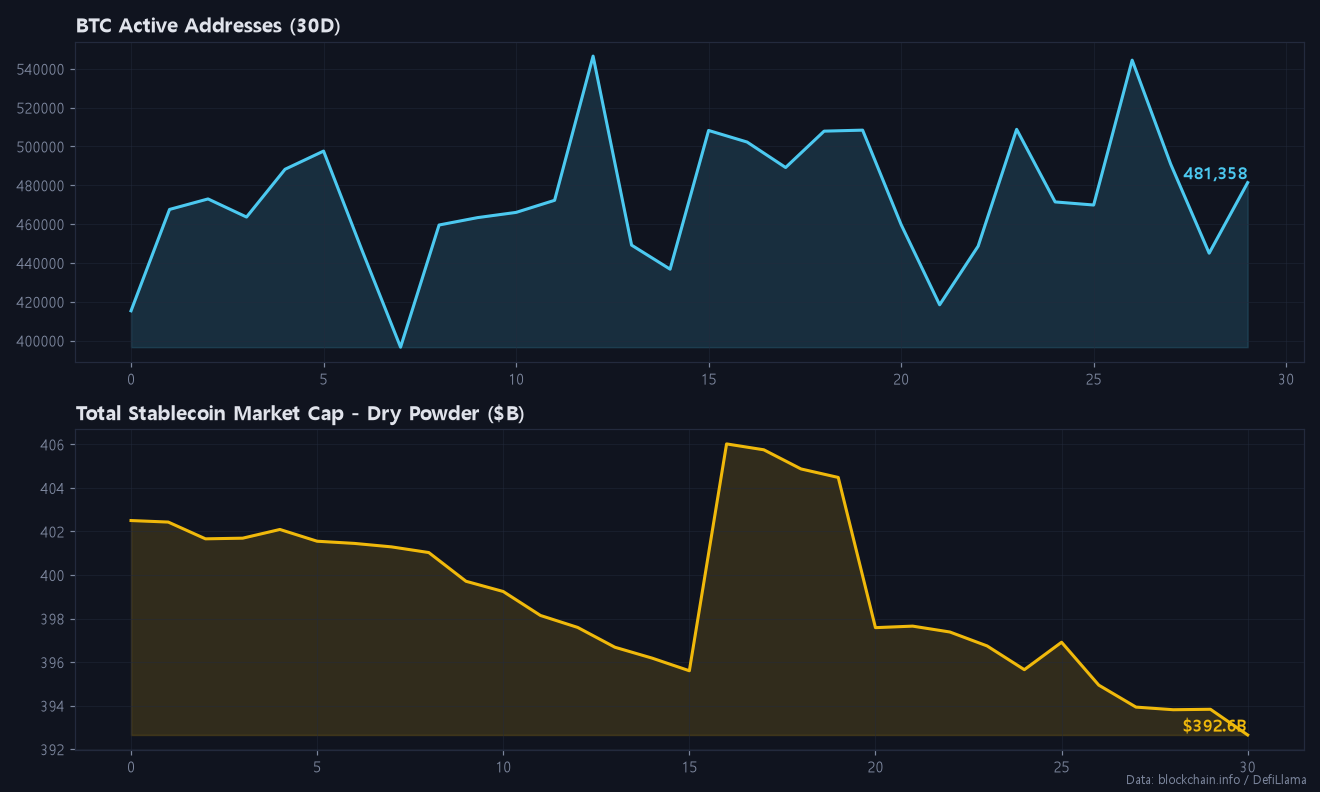
The network itself is not showing the stress the price chart implies. Bitcoin active addresses came in at 481,358 today, slightly below the seven-day average of 487,380 but 1.7% above the 30-day average. Transaction count jumped to 810,857, about 30.1% above its 30-day norm. That kind of activity spike during a selloff usually reflects coins moving between holders and exchanges, which is repositioning rather than abandonment.
Hashrate sits at 1,099.1 EH/s, down only 0.5% over 30 days. Miners are not capitulating, and the security budget remains intact. Mempool fees are just 4 sat/vB, so there is no panic congestion either.
The weak spot is stablecoin supply. Total stablecoin market cap has dropped to $392.7B, down $4.08B over seven days and $9.84B over 30 days. Stablecoins are the dry powder for crypto buying. When that pool shrinks, capital is leaving the ecosystem rather than waiting on the sidelines inside it, and that matches the AI-rotation thesis closely. As the on-chain chart below shows, usage is steady while the liquidity base is slowly draining.
What are today’s key Bitcoin support levels?
| Asset | Price | 7D change | Support | Resistance |
|---|---|---|---|---|
| BTC | $63,972 | ▼ 12.97% | $62,500 / $60,000 | $67,500 |
| ETH | $1,802 | ▼ 12.16% | $1,750 | $1,950 |
| SOL | $73.13 | ▼ 12.03% | $70 | $75 / $80 |
| XRP | $0.969 | ▼ 9.35% | $0.92 | $1.05 |
| HYPE | $68.32 | ▼ 5.39% | n/a | n/a |
BTC: dominance at 58% says this is a de-risking, not an altseason
Bitcoin dominance stands at 58.33%. In a true crypto-native panic, you would expect dominance to spike as altcoins get crushed. Instead, majors are falling roughly in lockstep, which again points to broad capital exiting rather than rotation within crypto. First support is $62,500, with $60,000 as the psychological floor. Resistance is $67,500.
ETH: Glamsterdam is a real upgrade risk
Ether at $1,802 is down 12.16% on the week, and the Glamsterdam upgrade adds a specific overhang. Reports suggest up to 15,000 automated applications could face breakage. That does not mean they will break, but it gives large holders a reason to wait. Watch $1,750 as support and $1,950 as resistance.
SOL and XRP: modest relative strength
Solana gained 2.53% and XRP 1.64% over 24 hours, outperforming BTC on the day. SOL needs to clear $75, then $80, to turn this into something more than a relief bounce, with $70 as support. XRP is holding above $0.92; $1.05 is the level that would reset the trend.
HYPE: the perp DEX that keeps holding up
Hyperliquid is down only 5.39% for the week at $68.32, less than half of BTC’s drawdown. Volatility is good for a perpetuals exchange’s fee revenue, and HYPE’s resilience suggests the market is rewarding protocols that earn more when everyone else is stressed.
Is Bitcoin oversold right now? Futures positioning
Sentiment is extreme, but leverage is not. Long accounts make up 75.5% of positions (long/short ratio 3.08), so retail is leaning heavily long into the decline. Funding is nearly neutral at 0.003%, and open interest fell 0.8% in 24 hours, so nobody is levering up aggressively. The structure is not overheated, yet that crowded retail long book is exactly what fuels a liquidation cascade if $62,500 gives way.
Given the 5.1% yield and synchronized weakness in equities, my short-term bias is neutral to slightly bearish.
- Short scenario: scale in on a bounce into $66,000-$67,500. Invalidation above $68,500. Targets $62,500, then $60,000.
- Long scenario: only on a sweep below $60,000 that reclaims the level quickly. Invalidation below $58,500. Target $64,000-$66,000.
- Avoid chasing shorts here. Extreme fear readings of 10-12 have historically produced violent short squeezes.
Scaling into positions means more fills, and fees add up fast in choppy markets. If you trade frequently, it is worth checking a BingX fee payback program for active futures traders or a Bitunix referral guide with up to 70% fee rebates. Fee-payback signup links are also at the end of the post.
My view: the December bottom is plausible, but rates decide it
I think VanEck is broadly right. This looks like a liquidity problem, not a solvency problem, and liquidity problems tend to resolve once the competing supply event is absorbed. Once the IPO allocation is digested and Wall Street re-entry continues, Bitcoin has a credible path to stabilizing in the low $60,000s. I would not, however, call a bottom while the 10-year sits at 5.1%. The yield is the real gatekeeper, not the IPO calendar.
Risk warning: with 75.5% of accounts long, a clean break of $62,500 could trigger cascading liquidations toward $60,000 or below within hours. Size positions so a gap through support does not force you out.
What would invalidate the December-bottom thesis?
- A weekly close below $60,000, turning the psychological floor into resistance.
- The 10-year yield pushing decisively above 5.1%, which would tighten conditions for every risk asset.
- Stablecoin market cap continuing to bleed past the current $9.84B monthly decline, signaling a deeper capital exit.
- Open interest rising while funding turns sharply negative, meaning aggressive shorts are piling in.
- Another round of ETF and institutional outflows reversing the recent re-entry.
FAQ
Why is Bitcoin down 13% this week?
Bitcoin fell 12.97% in seven days as AI IPO demand drained speculative liquidity and the US 10-year yield held near 5.1%, according to VanEck’s capital-rotation view.
What is Bitcoin’s key support level today?
First support is $62,500, with $60,000 as psychological support. Resistance sits at $67,500, while BTC trades near $63,972.
Is crypto sentiment at a bottom?
The Fear & Greed Index reads 12 (Extreme Fear), a level often seen near local bottoms. Shrinking stablecoin supply ($392.7B) suggests the recovery may take time.
If you found today’s post helpful, please subscribe and like.
Real-time briefings and new-post alerts on Telegram: t.me/corecryptoinsights · Follow on X: @core_trading1
If you’ve been trading without a fee payback, you’ve been losing money this whole time — start getting your trading fees back today.
▶ BingX 45% fee payback — full sign-up guide
▶ Bitunix 70% fee payback — full sign-up guide
▶ BingX vs Bitunix — which saves you more?
Leave a Reply